Categories
Asia Japan Travel

What to See in Japan in 12 Days

While interning in Japan, I was lucky enough to have my family come visit me for 6 days! While it was initially exciting, the thought of seeing my family after 3 months, but quickly I realized the enormous task in front of me: showing them the best Japan can offer in less than a week. I had visited quite a few of Japan’s cities so far, and had recommendations from coworkers, so I was able to put together a pretty good list!

  1. Tokyo : 3 Days (obviously). Once we met in Osaka, we took the bullet train to Tokyo we headed to our Airbnb. There is so much to see in Tokyo, we took no time at all before we headed off to Asuka, the temples in Tokyo, followed by a walk around Akihabara, a huge shopping area known for its large collection of anime and manga stores.
Bullet Train (Shinkansen) from Osaka to Tokyo
Family on Bullet train
Walking to Asuka Surrounded by Souvenir Shops

The next morning we started the day at the Imperial Palace. Although you are not allowed inside the palace, it is free to walk around the gardens! Next stop: Harajuku! Shopping center of Tokyo! We battled the enormous crowds to walk through this unique street and stopped to get delicious crepes along the way.

Imperial Palace Gardens
Crepes at Harajuku
Entrance of Harajuku

After crepes for lunch in Harajuku, we made our way to Ueno park, a massive park in the heart of Tokyo. The last stop of the whirlwind day before heading home for dinner was Shibuya and Shibuya crossing. You may remember this place from a previous blog, it is famous for its gigantic crossing area because it is so busy!

Ueno Park
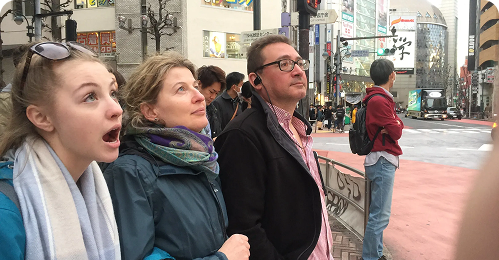
Shibuya Crossing

2. Hakone: 2 days. Just a couple hours outside of Tokyo by train is Hakone, famous for is onsens (hot springs) and picturesque views of Mount Fuji. Unfortunately, the couple days we were here it was cloudy and rainy which meant no views of Mount Fuji. Don’t get me wrong, we did try our hardest to see the views! We visited the edge of Lake Ashi and Fuji-Hakone-Izu National park, but it was cold and cloudy so the best we saw was Torii in the distance. The Airbnb we rented in Hakone though was spectacular with its own onsen inside! There my mother and I sat all night and drank Plum sake (like fruit juice but better). The trains in Hakone are very old fashioned but very cute and do their purpose to both be functional and an additional attractions of Hakone!

In the morning we forged through the wet weather and waited for the Hakone train back to the shinkansen station (Hakone is a bit out of the way from other cities and would be much more manageable by car, which many Japanese families do).

Lake Ashi
View from Hakone Airbnb
Hakone Local Train!
Me waiting for a train in Hakone

3. Kyoto: 4 days. Getting from Hakone to Kyoto was very easy by bullet train, and in just a few short hours we arrived at our Airbnb in Kyoto! This is one of my favorite cities; there are endless things to do. Our Airbnb was right next to the famous Fushimi Inari temple so we started off there! Depending on how much you want to climb, this temple can take hours, but most people only walk a little of the ways up before turning around. If you have time, I do recommend trying to walk to the top; besides some amazing views at the top, it also gets much quieter and it feels less touristy.

Fushimi Inari Temple

The following morning, on our way to the Kiyomizudera temple we passed through an enormous graveyard right next to the temple. Kiyomizudera temple is right at the edge of Higashiyama, a district of old streets in Kyoto lined with great trinket shops and food!

First look at Kiyomizudera temple
Kiyomizudera Temple
Higashiyama
Higashiyama
Mum and Gemma trying Yuba (Tofu and Cheese)

Continuing a long day of walking, we saw Ryozen kannon Buddha temple, Yasaka shrine, and the Sammon gate before proceeding to world heritage site Nijo Castle.

Nijo Castle

The next day we started off the morning with a walk down Philosopher’s path leading us to Heian Shrine and Honen temple. As a warning, the Philosopher’s path is a bit of a walk from the closest train station and you have to walk quite a bit on the path to get to the temples. There are buses but I have never been good at navigating buses.

Heian Shrine
Philosopher’s Path
Honen Temple
Honen Temple

4. Nara: 1/2 day. In the afternoon, we took a train over to Nara which is just an hour away to visit the deer park and big buddha before returning to Kyoto for the evening. All the temples you want to see, Todai-ji and Kofuku-ji, are inside the Nara deer park so it makes it very easy to see everything in one swoop.

Nara Deer Park
Todai-ji temple
Giant Buddha Inside Todai-ji temple

For our last day in Kyoto, we did one more trip up Fushimi Inari (my favorite temple) and then headed to Arashiyama district in Kyoto where there is the Arashiyama bamboo forest and monkey park! Pro tip: get to Arashiyama super early, like the crack of dawn, if you don’t want to deal with a huge amount of tourists and then you can snap cool photos! If you want to hear more about Arashiyama, please go see my blog post Bamboo Forest and Monkey Park. (I don’t want to make this blog too long.)

Arashiyama Bamboo Forest
On the Train to Arashiyama
Arashiyama Monkey Park

5. Hiroshima: 2 days. From Kyoto, we make the trek south where we arrive in Hiroshima. Since we had such a short time in Hiroshima, we thought it best to sign up for the Hiroshima Tourist bus that dropped us off at every sight much more conveniently than train and because it was a tourist bus they translated everything to English! We went first to Miyajima island, highly recommended by all my Japanese coworkers, which has the Itsukushima temple as well as lots of deer.

Miyajima Island

After, we obviously had to head to the Hiroshima Peace Memorial museum and surrounding park which documents the cause and effects of the Hiroshima atomic bomb. I don’t want to delve into all the parts of Hiroshima here, so if you are interested in reading more about this city please see my Hiroshima blog post.

Remains of Government building in Hiroshima Peace Memorial Park

6. Osaka: 2 days. Our last stop was Osaka because that’s where my internship was. We went to see Osaka castle and we were lucky because the cherry blossoms had just started blooming (only happens for a couple weeks every year) so it was a gorgeous walk. We also had Osaka’s Okinomiyaki.

Walls and Moat of Osaka Castle
Cherry Blossoms in Osaka Castle Park

The last night we went out for curry, and I’m sitting here right now writing as if they have already left, but their flight isn’t until tomorrow morning. But, I work tomorrow so I can’t see them off as I’d hoped. Despite the classic family arguments that are inevitable when travelling, I am feeling a loneliness creep back that I haven’t felt this strongly since the first few weeks of being here. Everything is great in Japan, but being with my family for the past week and then suddenly going back to my usual routine brought back some homesickness I thought I had left long behind. I guess it goes to show me that no matter how far or how long I am away from my family, that I’ll still miss them.

Last meal with family: curry
Categories
Asia Japan Travel

Bamboo Forest and Monkey Park

I am obsessed with Kyoto. This has been my third trip to Kyoto and I still haven’t seen everything! Kyoto boasts over 1600 temples and old fashioned Japanese roads lined with temples, restaurants, food shops, gift stores, and then -wait for it- more temples. This time, I went with my family who were visiting me for the week, and we spent four night in Kyoto. I took them to see a lot of what I have seen before simply because it is all so beautiful, but I had planned two days of new sights: Arashiyama and Fushimi Inari.

Fushimi Inari is a famous temple in Kyoto, but most temples in Kyoto are world famous, so I had no idea that this was the textbook pictures and Pinterest pictures of one of the coolest Japanese temples out there. We set out at 8AM (because there’s a lot of walking to get to the top of the temple and the crowds get really thick later in the day) and we knew even from a few blocks out that we were getting close to the temple because we could see the characteristically Japanese orange temple gates (called Torii) arching the streets. We turned another street corner and were immediately blinded by the crimson orange of all the Torii and painted temple complex.

It’s a very impressive site, even if you have already seen many of the other temples in Kyoto, but we didn’t realize how gargantuan the temple is until we passed the largest shrines and were met with even more Torii covering stairs leading up the mountain.

Entrance of Fushimi Inari Torii

The first few hundred meters, everyone wants to stop and take pictures because it is so beautiful, but 10 minutes further and most people stop taking photos because they are concentrating all their effort onto climbing the endless stairs. 30 minutes in, we FINALLY reach a map (which we learn later is not drawn accurately to scale whatsoever) that says we aren’t even half way! Another 30 minutes and we reach another map that indicates we have barely moved from where we were on the first map at all! The number of people climbing up the mountain begins to dwindle until it’s just me and my parents trudging up these ancient steps. Then we reach the top.

The view was beyond anything I could’ve imagined. How is it that so many hundreds of years ago, some monks thought “I’m going to build thousands of Torii up a mountain in a forest all the way up to this view.” We may never know, but thank you to those who built it! Even just thinking about how many feats this took puts me more in awe with Fushimi Inari.

When we tried to get back around the loop of the path, as the map had shown, we had some trouble. There were three unmarked paths which all were dead ends (yes, we tested every single one). Two hours later, after lumbering back on the path we came on and not finding any loop as was shown on the map, we made it to the temple entrance again and I was just about ready to shower and nap but it was only 10AM!

We followed Fushimi Inari up with a trip to Arashiyama, kind of a suburb to Kyoto famous for its bamboo forest and monkey park. (does the title of this blog post sound familiar now?) When you hear the names of those two attractions, I hope your heart starts to beat a little faster because they were just as amazing as they sound. The bamboo forest is about a 15 minute walk from the station, but you know precisely what route to follow because a long procession of tourists seems to be endlessly moving to and from the bamboo forest. When we arrived, the first thing that stuck out wasn’t the bamboo but all the tourists! It was so heavily packed, I had a hard time taking pictures. Eventually we found an offshoot with slightly fewer tour groups and stopped to take in the scenery (and snap a few pictures).

Retracing our steps back out of the bamboo forest, we followed a more inconspicuous path to a sign at the foot of some stairs with a picture of a Japanese Macaque monkey on it. I was warned that the monkey park was not extremely well marked and, honestly, if I hadn’t been warned in advance, I not only would have not found this monkey park but likely not planned to go there at all! You buy a ticket at the foot of the hill, but have to climb up steep stairs for 20 minutes and, near the end, I was seriously considering if they would give me a refund if I turned around before I was the monkeys. I persevered. And then soon after, without any signal of an enclosure, I spotted my first monkey hardly a meter away!

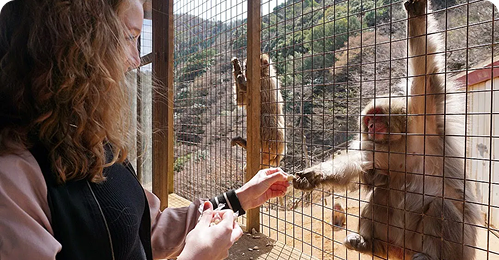
Then, we saw them everywhere! It was obvious there was no enclosure keeping the monkeys in; they were completely wild and chose to be their out of their own accord (most likely because they were well fed). It gets better still, we could go inside a room and FEED the monkeys ourselves!

These monkeys had such a privileged life lounging in the sun and being hand fed. This was, by far, one of my coolest experiences to date. (I know I say that every other blog, but every time I don’t think I can beat how cool something was, another Japanese experience comes along to blow the others out of the water.)

Categories
Asia Japan Travel

Kyoto

Behind the endless skyscrapers of Tokyo and Osaka, Japan portrays her culture and heritage in every aspect of Japanese life. None of this holds more true than in Japan’s old capital of Kyoto. On a day trip from Osaka, I arrived to Kyoto early in the morning with vain hopes to see everything in one day. My co-workers laughed when I suggested seeing all the temples and shops in one day, especially in such cold weather, and, despite my best efforts, I ended up not being able to see more than half of the city.

Kyoto is known to be a traditional Japanese city, and Japanese women come from all around to dress in traditional clothing and makeup and take pictures at various temples. The city is exactly how you would expect a Japanese city to look, with small winding streets lined with shops selling souvenirs and Japanese sweets and occasionally a doorway into a small temple.

While exploring the old streets, occasionally you turn and find yourself looking at a massive temple you were not even looking for.

From the train station to the first temple I wanted to visit was quite a walk, and so I made sure to take plenty of time to stop and try the local sweets and gift shops.

Having not even made it to the first temple I planned to visit, I had already seen over 20 temples! But the biggest surprise to come was up this long flight of stairs many people seemed to be climbing; the staircase was so long that you couldn’t see what was at the top. On a whim, I decided to follow the crowd off the main street, up these stairs and once I reached the top I was awestruck. A gigantic temple with an even larger statue of buddha was staring directly at me.

Around every corner of Kyoto there was another surprise, but eventually I made it to the first temple I had planned to see: Kiyomizu Temple

Kiyomizu temple is a complex with many temples, unfortunately most of which were under construction when I visited. However, the ones not under construction were vividly painted white with orange accents and, not surprisingly, drew quite a crowd.

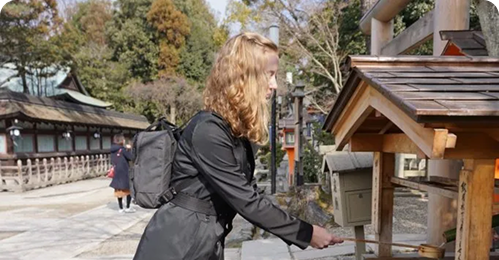
Learning how to enter all these temples without offending local culture was a challenge, but by just staying quiet and being respectful of my surroundings I seemed to not upset anyone. One common practice people did, especially at the bigger temples, was to wash their hands before entering them in a sink like this.

After visiting many temples, I started to understand more about the cultural symbols I had been seeing so far while in Japan. For example, at many of the temples you can buy charms such as for good health that you put in your bag to supposedly give you that charm’s attribute. I had seen many of these charms on peoples bags traveling to and from work, but didn’t understand what they were until coming to Kyoto. Another example is that hung by many smaller shrines, there are these wooden disks tied to parts of the shrine with writing. On these disks, which people buy them in stores in Kyoto, they write wishes before tying them to the shrine.

Exploring Kyoto gave me an entirely new perspective of Japan. While Osaka, where I live and work, contains the hustle and bustle of modern, technologically advanced Japan, Kyoto holds fast to the cultural heritage that embodies Japan. I feel humbled to be allowed to see such beautiful temples and statues, some created over 500 years ago. In America, we appreciate our history in so much of a different way than in Japan. Instead of embracing our history and preserving it in our cities, we remember our history to push us forward and seek new heights (e.g. the American Dream). One of the best things about traveling is comparing and contrasting your home culture to the one you are in, and it was astonishing to think that America has nothing close to what Japan has with Kyoto. America does not have an entire city dedicated to preserving its magnificent past. Yes, we have museums and colonial Williamsburg, but it pales in comparison to living, breathing and feeling the past where the present is still thriving. Kyoto is so hard to explain without visiting it yourself and I would highly recommend travelling to Kyoto if you find yourself in Tokyo, Osaka or another part of Japan. However, there is so much to see I will need to head back soon, hopefully during cherry blossom season!

Categories
Asia Japan Travel

Hello Kitty Restaurant

Japanese pop culture has many unusual quirks such as J-Pop (Japanese pop music), slapstick game shows and anime cosplay. But one facet of Japanese pop culture I was not expecting is this real, and some might call extreme, love of all things Hello Kitty.

I first began noticing little pictures of a white cat and pink bow on the corner of chocolate boxes and advertisements on trains or on the pockets of some women’s shirts. Once in awhile I might spot a pink umbrella covered in faces of hello kitty or girls wearing socks sporting a similar design. However, I chalked this up to Hello Kitty simply being more popular than in the United States, little did I realize yet how much more popular it was.

On a long day of sightseeing, I passed by a window display advertising Hello Kitty themed desserts. Partially because of my sweet tooth, and partially from hunger, I decided I would go try one. I entered the store to which the window display was a part of, and instead of a counter to order the desserts, I was bombarded by all manner of things Hello Kitty: bookbags, keychains, wallets, sweatshirts, stuffed animals, postcards and moe. I strode through the store, determined not to be tempted to buy more Hello Kitty goods than I had planned, and once I reached the back of the store it opened up into a little mall with more Hello Kitty stores!

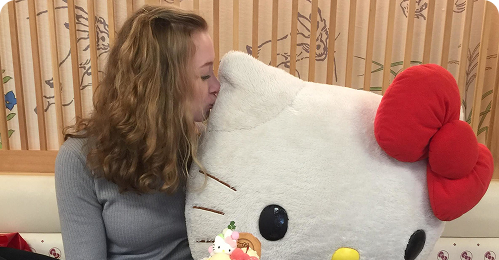
Finally I found the store in the mini Hello Kitty Mall that was selling the desserts; relieved, I immediately sat down and ordered. While I was waiting for my dessert to arrive, I took in my surroundings which was the Hello Kitty restaurant. Everything was pink, with one wall decorated in Hello Kitty wallpaper, and another wall was cut out with a floor to ceiling window giving gorgeous views into a private, pristine Japanese garden complete with a waterfall. To my right, I noticed two women eating curry rice, but the rice was shaped and dyed in the fashion of Hello Kitty! That is when I first noticed a life size, stuffed Hello Kitty sitting with the women. At first, I imagined the women must have brought the Hello Kitty from home or purchases it in one of the many many Hello Kitty stores, but as I began to look closer, not just at the decorations but at the eating companions of many diners, I saw that they, too, had life sized Hello Kitties next to them! The waitress must have seen my puzzled expression because she soon came over to me with another life sized Hello Kitty, extending it towards me with both hands and offering “picture?” The desserts arrived closely behind the waitress offering me the Hello Kitty, so a joint photo shoot occurred with me, the Hello Kitty and the desserts.

The desserts were yummy, however slightly overpriced. It was quite the experience!

    Share Your Story