

βœ•

Classroom Science

Every Scientist Had a Great Classroom Moment

Get Hands On

Experiments worth clearing a desk for

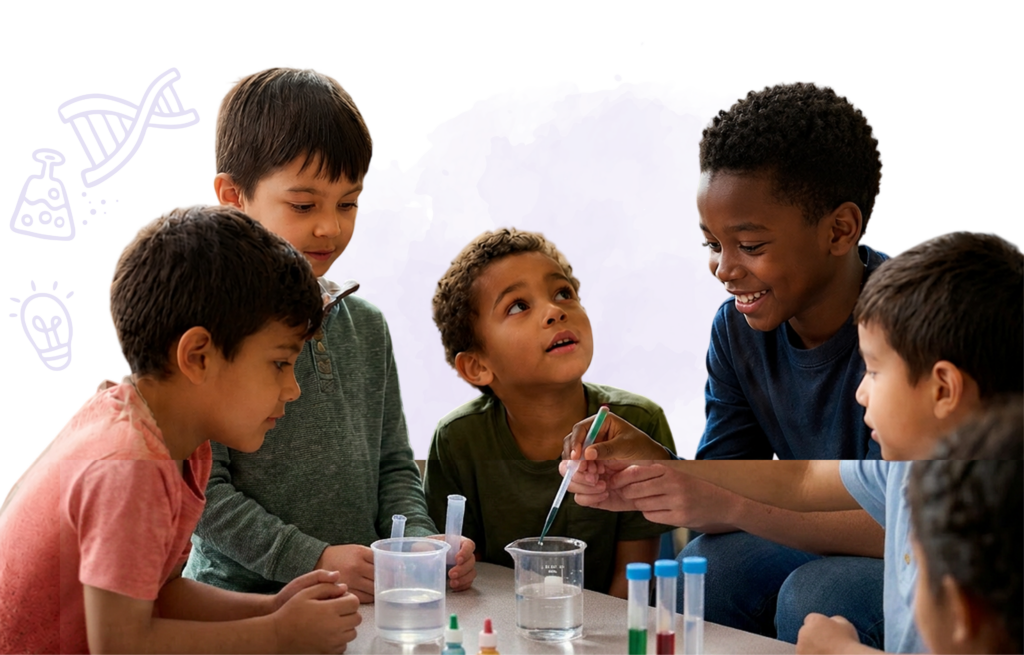
Hands-on, low-prep, and really interesting, each one designed to make students ask why before they even finish setting up.

Milk Plastic

Turn ordinary milk into a moldable bioplastic using simple kitchen chemistry, a perfect, tactile introduction to how polymers work.

Try It

Elephant Toothpaste

Yeast and hydrogen peroxide collide to create a dramatic foamy eruption, a crowd-pleasing way to demonstrate catalytic reactions.

Try It

Lung Model

A plastic bottle, balloon, and straw come together to build a working model of how lungs breathe, science that connects directly to the human body.

Try It

Soap Bubble Geometry

Soap films always find the most efficient shape, a beautiful, visual demonstration of surface tension that doubles as a geometry lesson.


Try It

Erosion Experiment

Compare how plants and bare soil respond to rainfall. Students see firsthand why roots matter for our land, rivers, and ecosystems.

Try It

Simple Electric Motor

A battery, wire, and magnet come together to build a spinning motor, a hands-on look at electromagnetism that students can take home.

Try It

Bookmark These

The Internet's

Good experiments are everywhere, if you know where to look. These six sites have done the hard work of finding and organizing them for you.

Khan Academy Science

Free video lessons and exercises covering biology, chemistry, physics, and more, aligned to school curricula at every grade level.

Steve Spangler Science

Dramatic, memorable classroom demonstrations paired with clear science explanations. Perfect when you want engagement first and theory second.

NASA STEM Engagement

Space-themed activities, engineering challenges, and lesson plans straight from NASA's education team, all free, all classroom-ready.

Science Buddies

Over 1,400 free science fair project ideas across every grade level, each with full materials lists, step-by-step instructions, and curriculum alignment.


Exploratorium Science Snacks

Bite-sized experiments from San Francisco's world-famous science museum, each using cheap, easy-to-find materials with big classroom impact.

PBS Kids Science Activities

Activity guides tied to PBS Kids shows, ideal for the youngest learners, ages 3 to 8, with minimal prep and maximum fun.



Make It Fun

Sneak Math Into the Fun

The best math lessons don't feel like math lessons. These six resources are proof, built for classrooms where engagement matters as much as the answer.

Math Playground

Word Problems

Grades 1-6

Hundreds of word problems sorted by grade level, students read, reason, and solve in a clean, distraction-free layout.

Play

Prodigy Math Game

Game

Grades 1-4

A fantasy RPG where every battle is solved with a math problem. Adaptive difficulty means it meets each student exactly where they are.

Play

Khan Academy Math

Practice

All Grades

Structured practice from counting to calculus, mastery-based progression with detailed explanations. The gold standard for free math learning.

Play

NRICH Maths

Problems

Ages 5–11

Rich mathematical problems and investigations from Cambridge University that encourage deep thinking, not just fast calculation.

Play

Cool Math Games

Games

Ages 6–14

Strategy and logic games that build mathematical thinking, students won't even realize they're practicing multiplication and problem-solving.

Play

Math is Fun - Puzzles

Puzzles

All Ages

Logic puzzles, riddles, and brain teasers alongside concept explainers. Great for early finishers or home enrichment.
Play

Before You Begin

Before You Hit Play on That Experiment

Because the best STEM lessons aren't planned around answers, they're built around questions, happy accidents, and a little student ownership

Always Start With "What Do YOU Think Will Happen?

Before anything, before the setup, before the demo, ask them to guess. The moment a student makes a prediction, they're invested. They need to know if they were right.

A Failed Experiment Is Still a Great Experiment

Something went sideways? Amazing. Ask the room, why did that happen? That curiosity in the chaos? That's real science happening right there.

Find the Science Already in Their World

Bridges, sneakers, fizzy drinks, thunderstorms, it's all science. Once students see it around them, they can't unsee it. That's the whole goal.

Give Them One Small Choice

Before anything, before the setup, before the demo, ask them to guess. The moment a student makes a prediction, they're invested. They need to know if they were right.

Next Steps

Want More Ideas

New experiments, fresh resources, and classroom-ready ideas, dropped straight into your inbox. Science never gets old, and neither does this newsletter.

    Share Your Story