Okay, I have to be honest with you. Every time I sit down to watch a science-heavy movie or TV show, I go in with the best intentions. I tell myself I’m going to enjoy it as fiction, suspend my disbelief, and have a good time like a normal person. And then approximately four minutes in, a character will do something in a lab that makes absolutely no sense, and I will spend the rest of the film quietly spiraling.
I know I’m not alone in this. Ask any scientist about their experience watching science on screen and you will get a very specific kind of tired smile. We have all been there. We have all sat through it.
But I don’t want this post to just be a list of complaints, because I think the tropes Hollywood reaches for again and again actually reveal something interesting, about how the public perceives scientists, about the stories we’re told about who belongs in science, and about why those stories matter more than they might seem. So let’s get into it.
The “Lone Genius” Problem
This is probably the biggest and most pervasive myth in science on screen, and it does real damage.
In the movies, science is done by one brilliant, tortured, slightly unhinged individual who works alone in a dramatic setting, usually at night, usually with some kind of eureka moment that changes everything, while the rest of the world fails to understand them. Think of nearly any famous scientist biopic. Think of the archetypal movie researcher scrawling equations on a window at 2am while their personal life falls apart in dramatically lit scenes around them.
Real science is collaborative. Almost entirely. The papers I published during my PhD had multiple authors on them, because that is how science actually works, you build on other people’s ideas, you work with a team, you depend on the expertise of people whose skills complement your own. Science is one of the most collective human endeavours there is, and yet on screen it is almost always framed as a solo sport.
Why does this matter? Because when young people, especially young people who don’t see themselves as “lone genius” types, watch these representations, they can get the message that science is not for them. That you have to be some kind of singular, exceptional, isolated visionary to belong in a lab. You don’t. You really, really don’t.
Scientists Are Always Working on Something World-Ending (Or World-Saving)
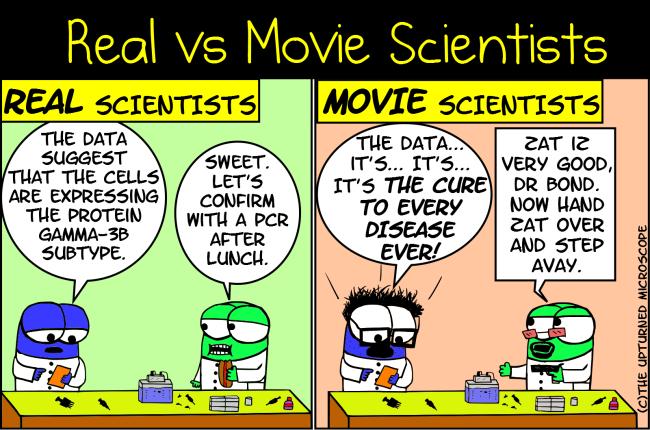
In TV and film, scientists are almost exclusively working on either something that is about to destroy civilization or something that will single-handedly save it. There is very little middle ground. Nobody is making incremental progress on a moderately important question about cellular recycling mechanisms in a cancer context, which is, you know, what I was actually doing for several years.
The reality of most scientific research is that it is slow, specific, and builds on a mountain of previous work in tiny, meaningful steps. A single paper rarely changes everything. A career is made of dozens of papers, each one nudging the needle a little further in a direction that may not pay off for decades, if ever. That is not dramatic. It is also genuinely beautiful if you understand what it means for the long arc of human knowledge, but it doesn’t make for easy two-hour storytelling.
The consequence of always showing world-scale stakes is that it sets an impossible standard for what counts as meaningful science. Students come into PhD programs expecting to cure cancer by year three, and when the reality of slow, methodical, frequently failing research sets in, it can feel like they’re doing something wrong. They’re not. They’re just doing actual science.
The Lab Aesthetics Are Unhinged
I say this with great affection and also genuine bafflement: real labs are usually much less cinematic than what we see on screen. .
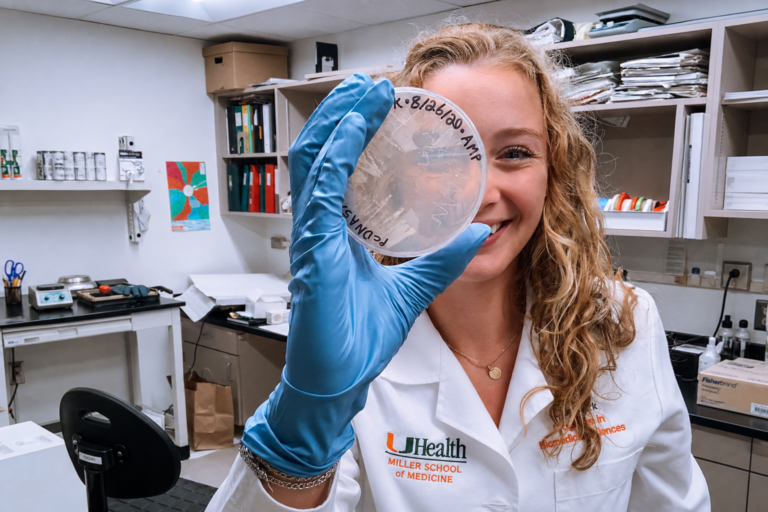
Real labs are, depending on the day, somewhat cluttered, fluorescently lit, and smell faintly of ethanol and someone’s lunch from three hours ago. There are sticky notes everywhere. There is always a centrifuge making a concerning noise that everyone has agreed to ignore. The whiteboard has a half-erased figure from a meeting that happened six weeks ago. Someone’s western blot is drying near the sink.
Movie labs are full of glowing blue liquids in beautifully shaped glassware, enormous holographic displays showing three-dimensional molecular models, and inexplicably dramatic lighting. Everything is either blindingly white and futuristic or dramatically dark and gothic. Nobody is wearing the correct PPE. The PI appears to have the entire lab to themselves and also possibly lives there.
I will say, the holographic molecular displays are getting closer to reality with some of the visualisation tools coming out of computational biology, so maybe Hollywood was slightly ahead on that one. But the glowing liquids? Please. No.
Women Scientists Are Always Having to Prove Themselves to a Skeptical Man
This one is getting better, slowly, but it is still a remarkably common story structure: brilliant woman scientist, dismissive male colleagues who don’t believe her, dramatic moment where she is vindicated. Sometimes she gets to be the hero. Sometimes she gets fridged to motivate the male protagonist. Either way, her gender is almost always a plot point rather than just a fact about her character.
What’s frustrating about this, beyond the obvious, is that it takes a real and ongoing structural issue in science and turns it into a narrative device. The challenges women face in STEM are real and worth talking about seriously. But reducing them to a dramatic conflict to be overcome in act two doesn’t really serve that conversation. It turns a systemic issue into a personal one, and it implicitly suggests that proving yourself to one skeptical man is the solution, rather than examining the broader structures that create the problem in the first place.
What Gets It Right
It would be unfair to end here without acknowledging the things that screen science gets genuinely right, or at least interestingly right.
The emotional experience of research, the obsession, the sleeplessness, the way a problem can take over your brain completely, that part is often well-captured. The grief of a failed experiment, the sudden electric excitement of a result coming together, the complicated relationship between a mentor and a trainee, these are real, and some films and shows do portray them with real nuance.
And increasingly, there are creators making science content on screen that are genuinely trying to get it right, shows that consult with scientists, that portray collaborative lab environments, that show female and non-white scientists as whole complex people rather than symbols. That’s worth celebrating.
Why It All Matters
You might be wondering why any of this is worth caring about. It’s just entertainment, right?
I’d push back on that. The stories we tell about who scientists are shape who feels welcome in science. They shape what the public expects from science, what they’re willing to fund, who they trust. They shape what a twelve-year-old watching TV decides is possible for them.
We can enjoy the drama and still want it to be better. We should want it to be better.