Categories
Research Advice

Communicating Science to Non-Scientists

Communicating science to non-scientists is a skill that takes time to build, and honestly, it’s not something most of us are formally trained to do. As scientists, we’re taught how to write papers, present data, and explain our work to people within our field. But once you step outside of that space, everything changes.

Most people you talk to won’t have the same background knowledge, and that’s where things can get tricky. It’s easy to default to the way we’ve always communicated, using technical language, going into detail, and explaining things step by step. But that approach doesn’t always translate well outside of a scientific setting.

In reality, communicating science to non-scientists is less about showing everything you know and more about making sure the other person understands what you’re saying. And that often means simplifying your message, even if it feels a little uncomfortable at first.

Know Your Audience

One of the most important things I’ve learned is that how you explain something depends entirely on who you’re talking to. There isn’t a single way to communicate science that works for everyone.

Talking to a friend, a family member, or someone outside of STEM is very different from talking to another researcher. You have to adjust your language, your examples, and even the level of detail you include. Not knowing your audience can make even the most interesting topic feel confusing or hard to follow

It also helps to think about what the other person already knows, or what they might assume. Starting from their perspective makes the conversation feel more natural and helps you build up the explanation in a way that actually makes sense to them.

Avoid Jargon

This is probably the hardest habit to break. Scientific language becomes so normal to us that we don’t always realize when we’re using jargon.

The problem is that jargon creates a barrier. Instead of helping someone understand your work, it forces them to decode the language first, and that can make them lose interest quickly. Using simpler words and shorter explanations makes it easier for people to focus on the actual idea rather than the wording

That doesn’t mean you have to oversimplify everything. It just means choosing words that are easier to follow and being mindful of how much technical detail you include.

Use Analogies

One of the easiest ways to explain complex ideas is by comparing them to something familiar. Analogies help bridge the gap between what someone already understands and what you’re trying to explain.

Instead of giving a detailed, technical explanation right away, it can help to start with a simple comparison. Once the person understands the basic idea, you can always add more detail if they’re interested.

This approach also makes conversations feel more engaging. It turns something that might feel abstract into something more relatable and easier to connect with

Focus on the Big Picture

As scientists, we’re trained to think about details, methods, data, controls, and all the specifics that go into research. But for someone outside the field, those details aren’t always the most important part.

What matters more is the big picture. Why does this research matter? What does it tell us? How does it connect to something people already care about?

Non-scientists tend to look for the takeaway first, rather than the full background or methodology

Starting with the bigger picture makes it easier for people to stay engaged and understand why your work is relevant.

Be Relatable

At the end of the day, communication is about connection. If something feels too distant or abstract, it’s harder for people to stay interested.

Relating your work to real-life situations, everyday experiences, or things people already care about makes a big difference. It helps shift the conversation from something that feels purely academic to something that feels more meaningful.

People are more likely to engage with science when they can see how it connects to their own lives or experiences.

Practice

Like anything else, communicating science gets easier with practice. The more you do it, the more comfortable you become adjusting your explanations and finding what works.

It also helps to pay attention to how people respond. If someone looks confused, that’s usually a sign to simplify or explain things differently. If they’re asking questions, that’s a good sign that they’re engaged.

Over time, you start to develop a better sense of how to communicate in different situations, and it becomes much more natural.


Categories
Research Advice

Virtual Conferences: Are They Worth It?

With everything moving online over the past few years, virtual conferences quickly became the default. What used to be something you’d travel for, flights, hotels, long days at convention centers, suddenly turned into something you could attend from your desk.

At first, I wasn’t sure how I felt about it. A big part of conferences, at least for me, was always the in-person experience, meeting people, walking through poster sessions, having those small conversations in between talks. So the question became: can a virtual format actually offer the same value?

The answer isn’t a simple yes or no. Virtual conferences are different, and once I adjusted my expectations, I started to see both the benefits and the limitations.

Pros

One of the biggest advantages of virtual conferences is accessibility. You don’t have to worry about travel, which immediately removes a lot of the cost and planning that usually comes with attending a conference. That alone makes it possible for more people to attend, especially students or early-career researchers who might not have funding.

Without travel and accommodation expenses, virtual conferences are significantly more affordable, and sometimes even free, making them easier to attend compared to traditional events

Another benefit is flexibility. Many virtual conferences record their sessions, which means you don’t have to choose between two talks happening at the same time. You can go back later and watch anything you missed. That’s something you don’t really get with in-person conferences, where once a session is over, it’s over.

There’s also something to be said about comfort. Being able to attend from home makes the experience less physically exhausting. You’re not walking all day, rushing between rooms, or trying to keep up with a packed schedule. It’s easier to pace yourself and take breaks when you need to.

Virtual conferences can also be more inclusive. People from different countries, time zones, or situations that make travel difficult can still participate. It opens up opportunities for a wider range of voices and perspectives, which is something that benefits everyone attending.

Cons

That being said, virtual conferences don’t fully replace the in-person experience.

The biggest thing that’s missing is the informal interaction. At in-person conferences, some of the most valuable moments happen outside of scheduled sessions, quick conversations after a talk, meeting someone while grabbing coffee, or just running into people throughout the day. Those moments are much harder to recreate online.

Even though virtual platforms try to include networking features, they often feel more structured and less natural compared to face-to-face interactions

Another challenge is staying focused. When you’re attending from home, there are more distractions. It’s easy to multitask or lose attention during longer sessions. Virtual fatigue is real, and sitting in front of a screen for hours at a time can be draining in a different way than being physically present.

There can also be technical issues. Whether it’s internet problems, platform glitches, or audio issues, these things can interrupt the experience in ways that you don’t usually deal with at in-person conferences.

And while accessibility is a major benefit, time zones can become a challenge. Live sessions might not always fit into your schedule, especially if the conference is being hosted in a different part of the world.

Are They Worth It?

I think virtual conferences are worth it, but in a different way than in-person conferences.

They’re great for learning, especially if your goal is to attend talks, hear about new research, or explore different areas of science. The ability to access recorded sessions and move at your own pace makes it easier to focus on the content itself.

They’re also a good option if you’re looking to attend more conferences without the added cost and time commitment of travel. You can participate in multiple events that you might not have been able to attend otherwise.

At the same time, if your main goal is networking or building strong professional connections, virtual conferences can feel more limited. The interactions are there, but they often require more effort and intention compared to the natural conversations that happen in person.

Overall, virtual conferences aren’t a replacement, they’re an alternative. They offer a different kind of value, and once you approach them with that mindset, it becomes easier to decide when they’re worth attending.

Categories
Research Advice

STEM Outreach: What is it and How to Get Involved

What is STEM Outreach

I’m sure many of you have heard about outreach before, and likely done it in some way, shape, or form, whether that was something you chose to do or something required in high school or college. At its core, outreach simply means reaching out and helping a community.

In STEM (Science, Technology, Engineering, and Mathematics), outreach takes that same idea and applies it to scientists, engineers, and researchers sharing their knowledge with a broader audience. It’s about stepping outside of the usual research environment and connecting with people who might not have that same background.

The goal of STEM outreach is to communicate STEM knowledge and techniques to everyone. Part of that is encouraging younger students to become interested in STEM and consider pursuing it as a career. But it’s also about showing that STEM isn’t an exclusive space. For a long time, it has been seen that way, and outreach helps break down that perception by making science more approachable and understandable

It’s also a really valuable skill to develop as a researcher. When you explain your work to a broader audience, you naturally become better at communicating. You learn how to simplify complex ideas, adjust your message depending on who you’re talking to, and focus on what really matters.

At the same time, outreach helps grow the field itself. The more people who are interested in STEM, the more ideas, perspectives, and innovation you bring into it. That can lead to stronger research overall and even more opportunities for funding, since many grants value outreach efforts

STEM outreach has actually been around for much longer than we often think. Even in ancient times, scientists would demonstrate experiments in front of audiences. That idea of sharing knowledge publicly isn’t new, it’s just evolved over time.

More recently, though, there’s been a bit of a disconnect between research and the general public. Research has become more complex, and at the same time, fewer people are directly exposed to how it actually works. Instead, much of what people see comes from media headlines, which often simplify or misinterpret findings.

That can lead to confusion, and over time, that confusion can turn into distrust. When people feel like they don’t fully understand something, it’s harder for them to trust it.

One of the simplest ways to address that is by explaining research in a way that’s clear and accessible. That’s really where STEM outreach becomes important, it helps bridge that gap and make science feel less distant and more understandable.

How to Get Involved in STEM Outreach

STEM outreach can take a lot of different forms. Traditionally, people think of it as giving talks, running workshops, or doing demonstrations for the public. But now, there are many more ways to get involved, especially with the growth of online platforms.

Below are some of the main ways to get started.

1. Joining Dedicated Organizations for STEM Outreach

There are many organizations focused specifically on connecting people with outreach opportunities. These can be national programs, university initiatives, or local community groups.

Some examples include programs that connect scientists with classrooms or organize events where researchers can interact directly with students. These types of organizations make it easier to get involved because they already have structure and support in place.

This is also one of the easiest ways to start. Instead of figuring everything out on your own, you can join something that’s already established and learn as you go. Many universities and workplaces also have their own outreach programs, so it’s always worth asking around or doing a quick search to see what’s available.

2. Starting a Social Media Account for your Research

Social media has opened up a completely new way to do STEM outreach. Platforms like Instagram, Twitter, and TikTok allow you to share science in a way that’s more accessible and easier to engage with.

If you decide to go this route, it helps to focus on one or two platforms rather than trying to do everything at once. It can get overwhelming quickly, especially if you’re also balancing research or other responsibilities.

It’s also helpful to have a general focus. That doesn’t mean you have to limit yourself, but having some consistency makes it easier for people to follow along and understand what you’re sharing.

3. Participating in Research Conferences/Forums

If stepping completely outside of the research environment feels intimidating, conferences are a good place to start.

Even though you’re still talking to other researchers, you often have to explain your work to people outside your specific field. That naturally pushes you to communicate more clearly and think about how you present your research.

It’s a lower-pressure way to start developing outreach skills, since you’re still in a familiar environment while learning how to adjust your communication.

4. Starting your Own Organization for STEM Outreach!

This is definitely the most ambitious option, but it can also be one of the most rewarding.

Sometimes existing organizations don’t quite match what you’re looking for, or you might have a specific idea you want to focus on. In those cases, starting your own initiative can give you more flexibility.

That could be something within your university, your department, or even something independent. The biggest thing here is having support, whether that’s from an institution, collaborators, or a small team to help share the workload.

It takes more effort, but it also allows you to shape the experience in a way that aligns with what you’re interested in.

5. Volunteering for Science Fairs

If you’re looking for something more low-commitment, volunteering at a local science fair is a great option.

It’s usually just a one-day commitment, so it’s easy to fit into your schedule. At the same time, it gives you the chance to interact with students, see different projects, and be part of the outreach experience without a long-term commitment.

It can also lead to other opportunities. You’ll meet people who are already involved in outreach, which can help you find new ways to get involved if you decide you enjoy it.

Categories
Chloe's Publication

Huntington’s disease: a rare cousin of Alzheimer’s

Many of us have heard of the neurological disorder Alzheimer’s disease, which affects 1 in 9 over the age of 65. But fewer are familiar with a rarer form of dementia called Huntington’s disease which affects just 5.7 of every 100,000 people.

Categories
Chloe's Publication

RhoGTPases and Their Regulators

An analysis of how GEFs and GAPs interact with and regulate Rho GTPases

Categories
Chloe's Publication

Did government policy spark a feminist movement and increase sexual assault reporting rates?

How the release of the 2011 Dear Colleague letter by President Obama’s administration fueled
the #MeToo movement and affected sexual assault reporting rates

Categories
Chloe's Publication

Can We Assume That People Read Contracts?

A Commentary Illuminating the Incongruity Between the Expectation that all Individuals Should
Read Contracts and the Realistic Infeasibility of Contract Reading, Culminating in a Suggested
Policy Change

Categories
Chloe's Publication

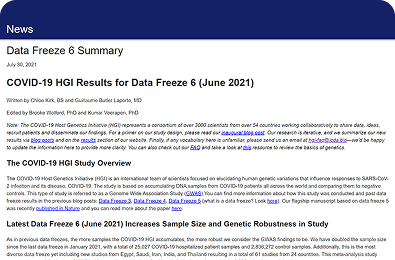
COVID-19 HGI Results for Data Freeze 6 (June 2021)

The COVID-19 Host Genetics Initiative (HGI) represents a consortium of over 3000 scientists from over 54 countries working collaboratively to share data, ideas, recruit patients and disseminate our findings. For a primer on our study design, please read our inaugural blog post. Our research is iterative, and we summarize our new results via blog posts and on the results section of our website. Finally, if any vocabulary here is unfamiliar, please send us an email at [email protected]—we’d be happy to update the information here to provide more clarity. You can also check out our FAQ and take a look at this resource to review the basics of genetics.

Categories
Chloe's Publication

Childhood exposure to science through museums

Childhood exposure to science through museums

Categories
Chloe's Publication

The Power of Social Media To Promote Science

Issue 23 of Scientifica Magazine “Into the Upside Down”

    Share Your Story