When most scientists think about careers in biotech or pharma, they picture research labs. Discovery work. Experiments, data, publications. But there’s an entirely different side of those industries that keeps everything running, and it’s one of the fastest-growing, most in-demand career tracks a scientist with a biology, chemistry, or engineering background can step into.
It’s called biomanufacturing. And there’s a very good chance no one mentioned it at your PhD orientation.
What is biomanufacturing, exactly?
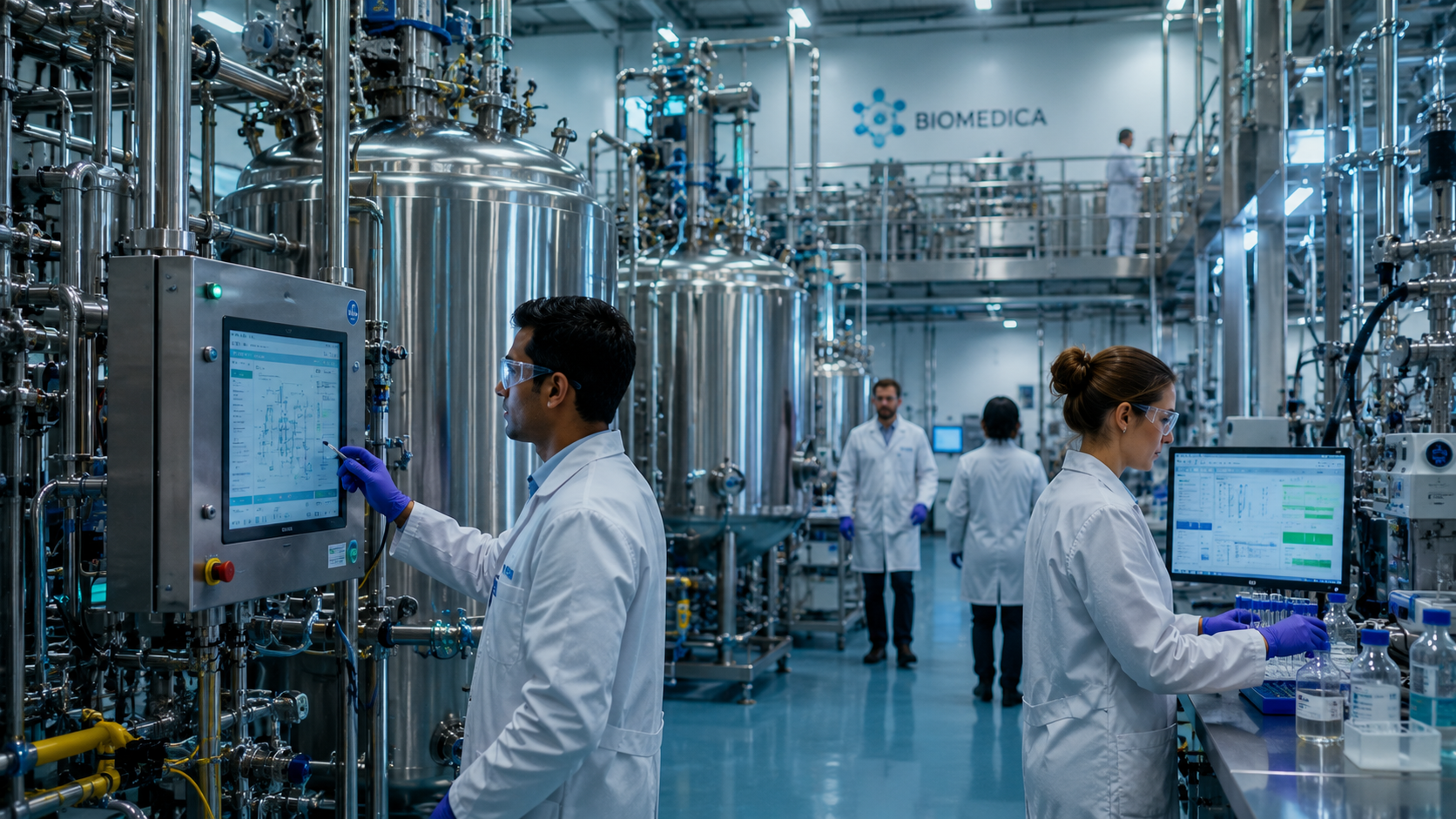
Biomanufacturing is the process of using living biological systems, cells, microorganisms, enzymes, to produce medicines, vaccines, and other biological products at scale . When a pharmaceutical company develops a new monoclonal antibody therapy or a vaccine, someone has to figure out how to make it reliably, consistently, and safely, not once in a lab flask, but thousands of times over, in large bioreactors, under strict regulatory oversight.
That’s biomanufacturing. And it covers a huge range of products: insulin, cancer therapies, gene and cell therapies, recombinant proteins, vaccines, the medicines people actually depend on .
The science doesn’t stop at discovery. Getting a biological product from a research bench to a patient requires an entirely separate, highly specialised field of expertise. That’s where biomanufacturing professionals come in.
This might be for you if you:
💡 Want to work in biotech or pharma without staying in research
💡 Like the idea of applied, problem-solving work with real-world stakes
💡 Enjoy working in structured, regulated environments where precision matters
💡 Are drawn to process thinking, how things work at scale, not just in theory
💡 Want clear deliverables and tangible outcomes from your work
💡 Are comfortable with shift work or non-traditional lab hours (this varies by role)
💡 Want strong job security, biomanufacturing is consistently hiring, and the talent gap is significant
What are the actual roles?
Biomanufacturing isn’t one job, it’s an entire ecosystem of roles. Here’s what the landscape actually looks like:
🔬 Process Development Scientist
Works on developing and optimising the biological processes used to make a product. Lots of bench work at this stage, figuring out the best growth conditions, yields, and parameters before scaling up. Strong scientific background is essential here.
🔬 Manufacturing Associate / Manufacturing Scientist
The hands-on role at the production floor. Responsible for running bioreactors, executing manufacturing protocols, monitoring critical process parameters, and making sure every batch is produced exactly as specified . This is where your lab skills translate most directly.
🔬 Quality Control (QC) Analyst
Tests and analyses samples at various stages of the manufacturing process to verify that the product meets required specifications. Detail-oriented, methodical, and absolutely critical, no product leaves a facility without QC sign-off .
🔬 Quality Assurance (QA) Specialist
Where QC tests the product, QA manages the systems that ensure quality, writing and reviewing Standard Operating Procedures (SOPs), handling deviations and investigations, managing compliance with regulatory requirements like FDA and GMP standards . It’s less lab-heavy and more documentation and process-focused.
🔬 Validation Engineer / Scientist
Responsible for proving, formally and documentably, that manufacturing equipment, processes, and systems consistently perform as intended. This is highly regulated work, and it’s where science meets documentation in a very detailed way.
🔬 Manufacturing Operations Manager
The leadership track. Oversees day-to-day manufacturing operations, manages teams, and ensures production timelines, quality standards, and regulatory requirements are all met simultaneously. Usually requires several years of experience in a more junior manufacturing role first.
What does a typical day look like?
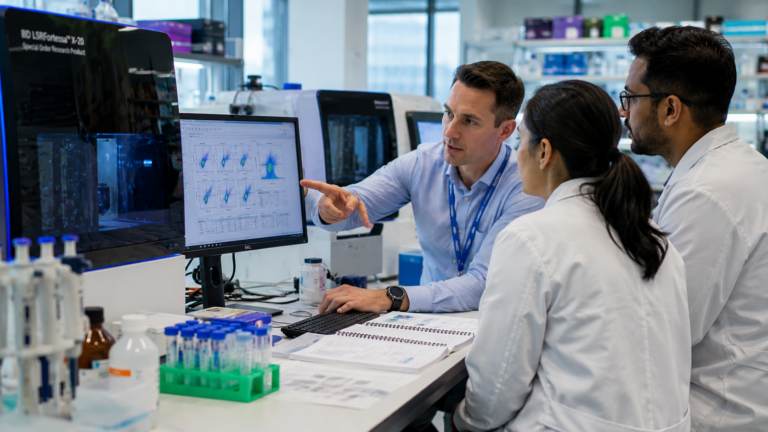
It depends heavily on which part of biomanufacturing you’re in. Process development feels closest to research, you’re still in a lab, designing experiments and collecting data, but the question you’re answering is “how do we make this scalable and reproducible?” rather than “what does this do?”
On the manufacturing floor, the work is more protocol-driven. You’re executing established processes, maintaining meticulous records, and ensuring that every single step is performed exactly as specified, because in a regulated manufacturing environment, consistency isn’t just good practice, it’s a legal requirement.
Both sides of biomanufacturing share one thing: the stakes are high, the standards are non-negotiable, and the work genuinely matters. The product at the end of your process is something a patient is going to receive. That doesn’t feel abstract for long.
Why do biomanufacturing companies want scientists?
Because biological processes are fundamentally complex, and when something goes wrong in a manufacturing run, a contamination event, an unexpected yield drop, an out-of-spec result, you need people who can troubleshoot at a scientific level, not just follow a checklist .
A background in cell biology, biochemistry, microbiology, or chemical engineering gives you the foundation to understand why a process behaves the way it does. That understanding is what separates someone who can execute a protocol from someone who can fix it when it breaks.
Things to keep in mind:
📚 GMP (Good Manufacturing Practice) is the regulatory framework that governs all biomanufacturing. Understanding what GMP means and why it exists is foundational knowledge for any role in this space, start familiarising yourself with it now, before your first interview .
📚 Documentation is non-negotiable. If it isn’t written down, it didn’t happen. The level of record-keeping in biomanufacturing is significantly higher than in research settings, and it takes adjustment for most scientists coming from academia.
📚 Shift work is common at the manufacturing level. Bioreactors don’t work 9 to 5. Depending on your role and facility, you may be working evenings, weekends, or rotating shifts. It’s worth understanding the schedule expectations before you accept a role.
📚 Biomanufacturing is actively hiring and has been for years. The talent gap between the number of open roles and the number of qualified candidates is real and well-documented . That’s genuinely good news if you’re considering this career, the demand for people with your background is not going away.
📚 Career progression can move quickly. Companies are growing, new facilities are opening, and people with strong scientific foundations who also understand manufacturing operations are advancing into leadership roles faster than in almost any other area of industry science.
Job titles to look for:
💻 Process Development Scientist / Associate
💻 Manufacturing Associate / Manufacturing Scientist
💻 Quality Control Analyst
💻 Quality Assurance Specialist
💻 Validation Scientist / Engineer
💻 Upstream / Downstream Processing Scientist
💻 Bioprocess Engineer
How to explore this career:
🗣️ Look at job postings from major biomanufacturing employers, Genentech, Amgen, Lonza, Thermo Fisher, Pfizer, Regeneron, and contract manufacturing organisations (CMOs) like Samsung Biologics and WuXi Biologics all hire heavily in this space.
🗣️ If your graduate work involved cell culture, fermentation, protein expression, or process-adjacent techniques, map those skills directly to biomanufacturing job descriptions. The overlap is almost always bigger than you think.
🗣️ Look into GMP training courses. Several universities and online platforms offer introductory GMP and biomanufacturing courses, completing one signals to employers that you’re serious and that you’ve done your homework.
🗣️ Reach out to scientists working in biomanufacturing on LinkedIn. Ask them what they wish they’d known before starting, and whether there are any entry points into the field they’d recommend for someone with your background.
🗣️ For a deeper read on what the biomanufacturing career track actually looks like from the inside, this piece from Science.org is worth your time: The Biomanufacturing Career Track, Science.org
Biomanufacturing is one of those career paths that rewards everything a science background gives you, the rigour, the problem-solving, the ability to think critically under pressure. You just get to apply it somewhere with a very different kind of finish line.
And that finish line? It’s a medicine that actually reaches a patient. That’s not nothing.