
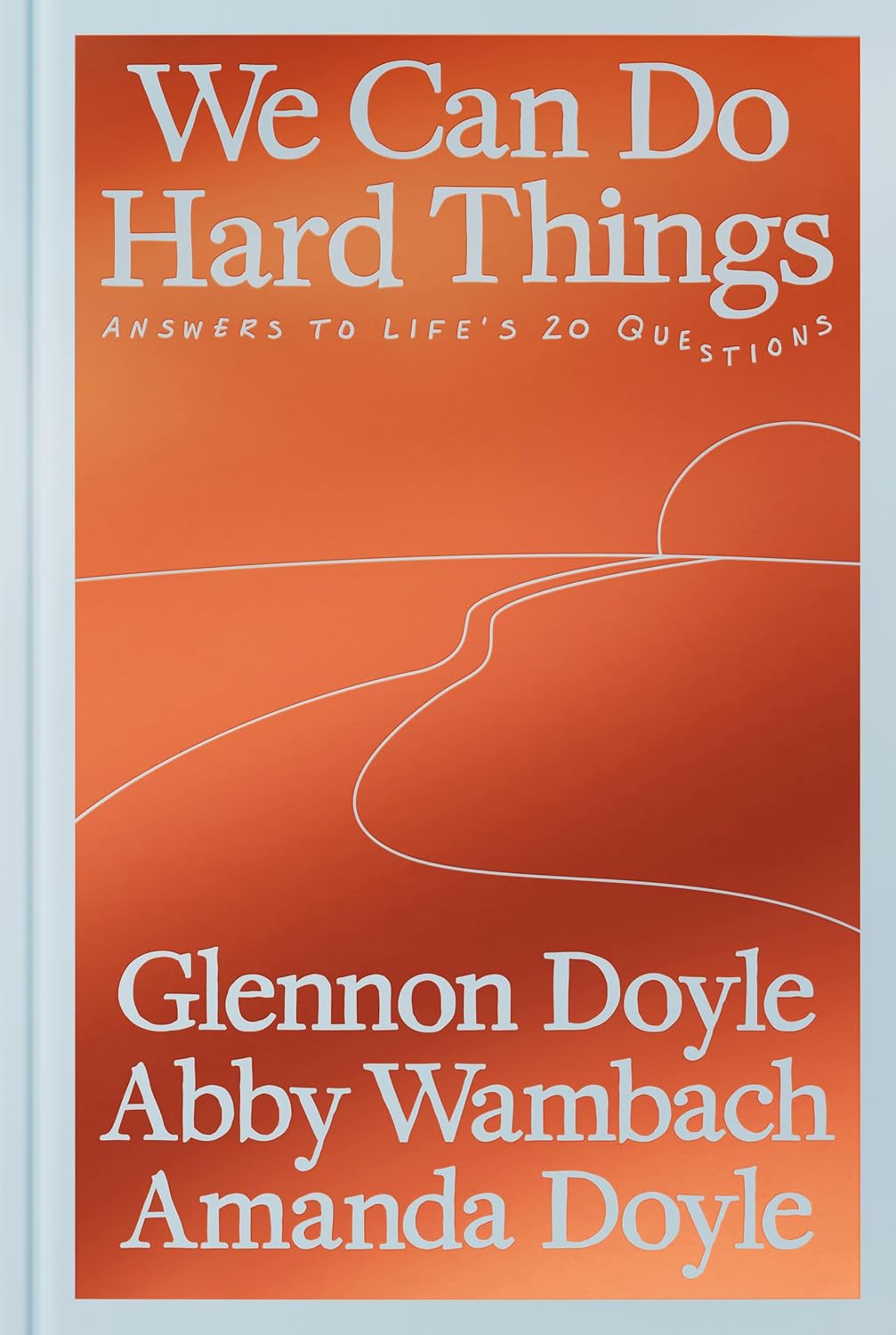
I want to be upfront with you: this wasn’t supposed to be a Science Read. I usually reserve this space for biological and physical sciences, the kind of books I can connect back to research, policy, cells, molecules, systems. This one is none of those things. And it is, without question, the most important book I’ve read this year. I’m a week late posting this, and I’m going to tell you exactly why.
What This Book Is Actually About
We Can Do Hard Things is built around a deceptively simple premise: that listening to your body, its signals, its grief, its stored emotions, its needs, is not separate from health. It is health. That western medicine, for all its extraordinary capability, has been treating the body as a biological system while largely ignoring the equally real and equally consequential inner landscape that shapes how we move through the world.
The book is written as a series of quotes and reflections rather than conventional chapters, which is not at all how I usually read. But that structure turns out to be exactly right for what the book is doing, it reads like one long, flowing conversation, each point arriving at exactly the moment it’s relevant, weaving together into a narrative that somehow manages to feel both universal and deeply personal at the same time. It breaks down the individual pieces that have made you who you are, and asks honest questions about how much of who you present to the world has been shaped by what society told you to hide.
What Got Me Thinking
I have to be honest with you about what this book actually did to me, because I think that’s the only way to honor it properly.
I cried reading this. More than I expected. I processed grief I didn’t know I was still carrying, about leaving academia, about losing my identity not once but twice in the space of two years. There is something about seeing your own experience reflected back at you in language that is honest and warm and completely without judgment that breaks something open. This book did that. Blame it for the late post. It took me somewhere I didn’t know I needed to go, and I had to stay there for a while before I could come back and write about it.
The section I keep returning to most is the one about productivity and self-worth, the idea that rest has to be earned, that a day without output is somehow a day less deserved of its small joys. I recognized myself so completely in that framing that it was uncomfortable. The narrative I had built around what I owe the world, and what I owe myself, in order to justify simply existing in a day is one I had never fully examined. This book held it up and asked me to look at it directly. And then, gently and without prescribing a single right answer, it suggested that reconstructing that narrative was possible. That leaning into every day being the best day ever, not as toxic positivity, but as a genuine reorientation toward what a day is actually for, was something worth trying.
What the book doesn’t do is equally important. It doesn’t hand you a ten-step plan. It doesn’t sell you on one right way to heal, because there isn’t one. That’s the most powerful message of all, that there are as many paths through hard things as there are people carrying them, and that the work of finding yours is yours alone to do, but you don’t have to do it in isolation.
Why I Think You Should Read This
Five out of five, and I say this as someone who would not normally pick up a psychology or self-help book. I understand if that’s not your usual territory. It isn’t mine either. But if you try one book outside your usual genre this year, please let it be this one. There are parts of it for every chapter of your life, and it will find the chapter you’re in right now with an accuracy that feels almost unfair.
This book made a convincing case for something I think science, in all its forms, sometimes forgets: that the data we collect from our bodies, the signals they send, the emotions they store, the grief they carry quietly for years, are as real and as worth attending to as any measurement we take in a lab. Western medicine is extraordinary. And it is incomplete without this.
My Takeaway
The thing I’m carrying most from this book is permission, which sounds small and turns out to be enormous. Permission to rest without earning it. Permission to grieve things that are over. Permission to reconstruct the story you’ve been telling yourself about what you have to be in order to deserve the life you’re living. Science gives us tools to understand the world outside our bodies with extraordinary precision. This book is a reminder that the world inside them deserves the same quality of attention, the same curiosity, the same care, the same willingness to sit with uncertainty and ask what’s actually true.
Come Read Along
Has a book ever found you at exactly the right moment and taken you somewhere you didn’t know you needed to go? I’d love to hear about it, in the comments, on Instagram, wherever feels right. This one was that book for me. I hope it finds you when you need it too.
October’s Science Read is Why Brains Need Friends by Dr. Rein, back to the science, and a book about something every scientist who has ever buried themselves in work at the expense of everything else probably needs to read. See you there.
With love,
Chloe 🩵