
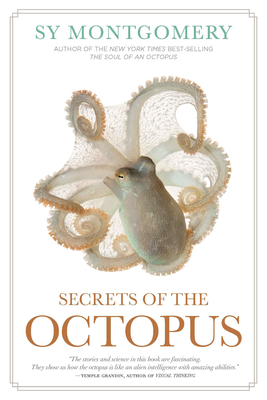
I need you to stop whatever you’re doing and consider the octopus for a moment. Three hearts. Blue blood. The ability to taste with every inch of their skin. The ability to squeeze their entire body through an opening the size of their own eyeball. If someone handed you this creature in a science fiction novel, you’d think the author was having a little too much fun. But octopuses are real, they’ve been on this planet for at least 328 million years, and it turns out we know remarkably little about them. Secrets of the Octopus fixed that for me, and it will fix it for you too.
What This Book Is Actually About
Secrets of the Octopus is a collaboration between naturalist Sy Montgomery and National Geographic, and it shows in the best possible way. This isn’t a dry scientific survey, it’s a genuine, wide-eyed celebration of one of the most alien creatures sharing our planet, written by someone who finds them as extraordinary as they actually are.
Montgomery takes readers through what scientists currently know about octopus intelligence, behavior, and biology, and more importantly, how much remains unknown. The research she covers spans everything from problem-solving and tool use to consciousness, personality, and social behavior. She frames this growing body of research as a kind of Copernican revolution, just as humans once had to reckon with the fact that Earth is not the center of the universe, we are now slowly coming to understand that humans are not the only intelligent species on this planet. That reframe doesn’t get old, no matter how many times science has to remind us of it.
What Got Me Thinking
Where do I even start. The facts in this book live in my head permanently now, and I want to pass that along.
The plural of octopus is octopuses, not octopi, because the word comes from Greek, not Latin. I’ve been correcting people about this ever since. Octopuses, squid, and cuttlefish can edit their own RNA, essentially manipulating their own genome in real time, a discovery made in 2017 that still feels like it should have made bigger headlines than it did. The last common ancestor between humans and octopuses was a flatworm, roughly 750 million years ago, and yet octopus brains are capable of advanced functions and problem solving comparable to chimpanzees. Two wildly different evolutionary paths arriving at similar cognitive destinations. That alone should stop you in your tracks.
And then there’s this: octopuses can change their appearance within one-fifth of a second, measured up to 177 times an hour, shifting specifically in response to the prey or predator in front of them. The precision of that is staggering.
But what I found most compelling, and most relevant to anyone who thinks about how we study intelligence and consciousness, is how difficult octopuses are to study. They don’t play along. They’re escape artists with distinct personalities and social behaviors that our standard scientific frameworks weren’t built to capture. That’s a genuinely important scientific problem: what happens when the subject of your research refuses to be a subject? It raises real questions about how we design experiments, what we’re actually measuring when we measure intelligence, and how much of what we call “unknown” is really just a limitation of our own methods.
Why I Think You Should Read This
A full 5/5, great for all ages, genuinely accessible to anyone, and paired with some of the most stunning photography I’ve seen in a science book in years. I ended up buying a physical copy specifically because the pictures are worth having on a shelf.
This is the kind of science communication that reminds you why science is exciting in the first place, not because it has all the answers, but because the questions are so much bigger and stranger than we imagined. If you loved An Immense World by Ed Yong for the way it opened up animal sensory experience, this book is a perfect companion. Both are fundamentally about the same thing: the humbling, wonderful reality that other creatures are experiencing a world we can barely begin to imagine.
My Takeaway
The thing I keep sitting with is how much of what we call “unknown” is actually a failure of imagination, or of method. Octopuses have been here for 328 million years. They are sophisticated, conscious, and behaviorally complex in ways we are only beginning to document. And yet so much of what they are remains outside our ability to measure, because we built our tools around studying minds that work like ours. That’s not just a biology problem. It’s a science communication problem, and a philosophy of science problem. The frameworks we use to ask questions shape the answers we’re capable of finding. Expanding those frameworks, being willing to say that intelligence, consciousness, and experience might look radically different from what we expect, feels like one of the most important things science can do right now.
Come Read Along
Are you an octopus person? Because after this book, I fully am. I’d love to hear what surprised you most, drop it in the comments or find me on Instagram.
May’s Science Read is The Anxious Generation by Jonathan Haidt, a complete tonal shift from the ocean floor, but every bit as thought-provoking. See you there. 📚