
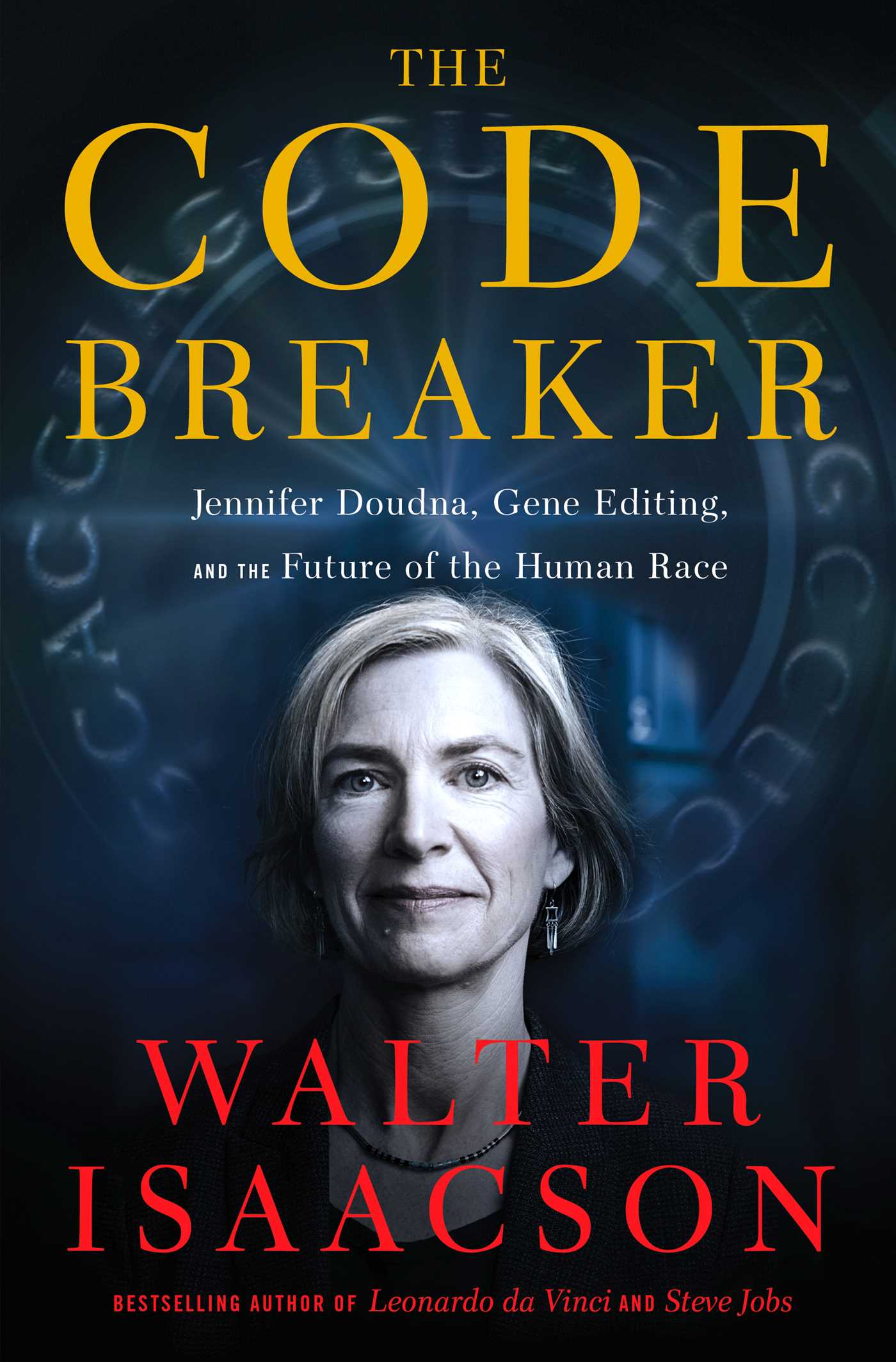
There are books that find you at the right moment. And then there are books that make you realize they were always going to find you, that the subject matter is so woven into who you became as a scientist that reading about it feels less like discovery and more like finally getting the full story of something you’ve been carrying for years. The Code Breaker was that book for me. Jennifer Doudna’s work on CRISPR-Cas9 was the subject of my first science report. My high school senior thesis. The thing that first made me feel like science was not just something that happened in textbooks but something that was happening right now, in ways that were going to change everything. I cannot believe it took me this long to read this book.
What This Book Is Actually About
The Code Breaker is Walter Isaacson’s biography of Jennifer Doudna, one of the most significant scientists of the twenty-first century, tracing her life from her early curiosity about biology through the research that earned her and her collaborator Emmanuelle Charpentier the 2020 Nobel Prize in Chemistry. The discovery at the center of the book is CRISPR-Cas9: a gene editing system that allows scientists to cut DNA at precise locations and let the cell’s natural repair process take over, with a specificity and accessibility that no previous gene editing technology had achieved.
But Isaacson, who also wrote the definitive biographies of Einstein, Jobs, and Leonardo da Vinci, understands that the most important stories in science are never just about the science. The Code Breaker is simultaneously a biography, a history of molecular biology, a patent dispute thriller, and a genuinely serious examination of what it means to hold this kind of power over the human genome. It is one of the best science books I have read in this entire series.
What Got Me Thinking
The patent dispute is one of the most fascinating and genuinely unresolved arguments in recent scientific history, and Isaacson covers it with appropriate complexity, while being honest about the fact that the book is told largely from Doudna’s perspective. The core of the dispute: Doudna and Charpentier demonstrated CRISPR-Cas9 working in a test tube environment. Feng Zhang at the Broad Institute argues that the leap to making it work in eukaryotic cells, the kind that make up human bodies, was the novel translational invention, and that he made that leap independently. The general scientific consensus credits Doudna and Charpentier with the foundational invention. But the patent suits that followed have been lengthy, expensive, and emotionally charged in a way that reveals how much is at stake when a technology is potentially worth billions.
What I found most compelling wasn’t the dispute itself but what it exposes about how science and commerce intersect at the moment of a breakthrough. Credit, priority, intellectual property, these are not separate from the science. They shape who gets to build on a discovery and how.
The ethical questions CRISPR opens are the ones I have been thinking about since high school, and the book handles them with more nuance than I expected. Cheap, accessible gene editing technology could eliminate hereditary diseases, revolutionize cancer treatment, and transform medicine in ways we are only beginning to map. It could also, without serious regulation and ethical frameworks, move us toward the kind of genetic stratification that Gattaca and Brave New World imagined as warnings. Could editing the germline weaken genetic diversity in ways we don’t yet understand? How do we ensure equitable access to technology this powerful? How much of the human genome should be considered editable, and by whose authority? Doudna herself has been one of the most vocal advocates for building those ethical guardrails before the technology outruns the conversation, and the book documents that advocacy with the same seriousness it brings to the science.
Why I Think You Should Read This
A full 5/5, new favorite book, no hesitation. Isaacson does what he does better than almost anyone: takes a story that could be dry or technical and makes it feel like the most important thing happening in the world right now, because it is. If you have any interest in genetics, medicine, biotechnology, scientific ethics, or the human drama of how discoveries actually get made and contested and built upon, this book is essential.
And if, like me, CRISPR was the thing that first made science feel urgent and alive for you, reading this will feel like coming home.
My Takeaway
The thing I keep sitting with is how much the ethical conversation around CRISPR has been shaped by the scientists who discovered it, and how unusual that is. Doudna could have stepped back from the policy debate and focused on the research. Instead she helped convene the conversations, push for regulatory frameworks, and insist that the scientific community take responsibility for where this technology goes. That’s science communication in its most consequential form, not explaining a discovery to the public, but using the authority that comes with a discovery to insist that the public conversation about it is the right one. That model of scientific responsibility is one I want to carry forward. The tools we build shape the world we live in. The scientists who build them have an obligation to help decide how.
Come Read Along
Were you following the CRISPR story as it unfolded, or did this book introduce you to it? I’d especially love to hear from anyone whose scientific path was shaped by CRISPR the way mine was. Drop it in the comments or find me on Instagram.
October’s Science Read is Genentech: The Beginnings of Biotechnology by Sally Smith Hughes, the origin story of the industry that made CRISPR’s promise possible in the first place. It felt right to follow this one with the book that goes back to where biotechnology began. See you there. 📚