
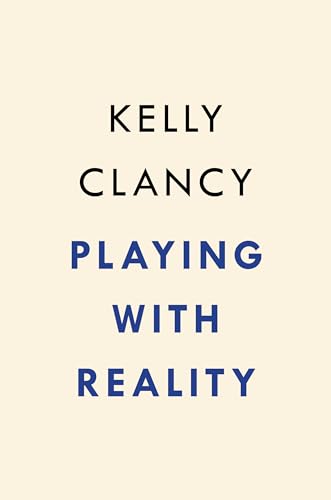
What if the way we play has fundamentally shaped the way we think? Not just as children, but as scientists, policymakers, and societies trying to make sense of an increasingly complex world. That question is what pulled me into Playing with Reality, and it’s the kind of book that starts as an intellectual curiosity and quietly becomes something you’re turning over in your head long after you’ve put it down. Also, fair warning: it may send you straight to your nearest board game shelf. More on that later.
What This Book Is Actually About
Playing with Reality is written by Dr. Kelly Clancy, a neuroscientist and physicist who studies how games have shaped the way humans generate knowledge and reason about the unknown. The book moves through the history of games, and specifically game theory, tracing how the frameworks we build around play have influenced everything from economics and military strategy to medicine and artificial intelligence.
Clancy is a genuinely fascinating guide for this kind of book. She brings both the scientific rigor of a physicist and the curiosity of someone who clearly finds games delightful, and that combination keeps the writing from ever feeling dry. Her central argument is that while games and game theory are powerful tools for modeling and predicting behavior, we’ve started leaning on them in ways that oversimplify reality, and that has real consequences for how we design systems that affect real people’s lives.
What Got Me Thinking
The section I found most unexpected, and most memorable, was Clancy’s use of game theory to explain how cancer is treated. Oncologists are increasingly using dynamic, game-theoretic modeling strategies to target cancer that is constantly evolving and adapting. The idea that a tumor can be approached like an opponent in a game, and that treatment can be designed with that strategic logic in mind, is genuinely fascinating. It’s one of those moments where a framework you thought belonged to economics suddenly illuminates something completely different.
But Clancy is careful not to oversell the model. One of the sharpest observations in the book is the distinction she draws between game theory and reality: in game theory, a player’s preferences can be understood through the choices they make, but in reality, many of the choices we make are driven by necessity, not desire. That gap, between the clean logic of a model and the messy truth of human lives, runs through the whole book. “People aren’t mathematical objects,” she writes, and it lands with the kind of quiet weight that good science writing earns when it’s being genuinely honest.
Her argument that we shouldn’t rely on game theory as heavily as we do, especially for complicated societal questions like universal healthcare, is worth sitting with. Games have clear rules. The real world doesn’t. And when you try to force real-world complexity into a framework built on clean constraints, the model starts serving itself rather than the problem it was built to solve. That’s a lesson that extends well beyond game theory, it applies to any time we mistake the map for the territory.
Why I Think You Should Read This
This is a 4/5 for me, and my only real wish is that Clancy had gone deeper on AI and the way games are being used to train machine intelligence. She does touch on it at the end with a question that genuinely stopped me: is true intelligence the best moves during a chess game, or is it what invents a game like chess? That’s the thread I wanted her to pull harder. The book gestures at the data harvesting from online games, the gamification of technology, the implications for misinformation and mental health, but it doesn’t linger there the way I was hoping it would.
What the book is, a rich, engaging history of games and game theory and their influence on human reasoning, it does beautifully. Go in knowing that’s the focus and you’ll enjoy it thoroughly.
One more thing: I’d highly recommend reading this alongside The Anxious Generation. Together they build a really compelling picture of how games and digital environments are shaping human minds and behavior, and what we might want to do about it.
My Takeaway
The question Clancy keeps circling, whether our models of reality are helping us understand the world or quietly distorting how we see it, is one I haven’t been able to shake. In science communication, we build frameworks and narratives to make complex ideas accessible. But there’s always a risk that the simplification starts doing too much work, that the clean story replaces the complicated truth. Games are powerful precisely because they impose order on uncertainty. The challenge is remembering that the order is the invention, and the uncertainty is the reality. That’s worth keeping close, whatever field you’re working in.
Come Read Along
Has a book ever sent you running to a hobby you hadn’t thought about in years? Because this one had me picking up Wingspan immediately, and I have zero regrets. Drop your thoughts in the comments or come find me on Instagram, I’d love to know if this one sparked anything for you.
Next Science Read is The Exceptions by Kate Zernike, the story of Nancy Hopkins and the women who fought for equity at MIT, and one of the most important science books I’ve read this year. See you there. 📚