
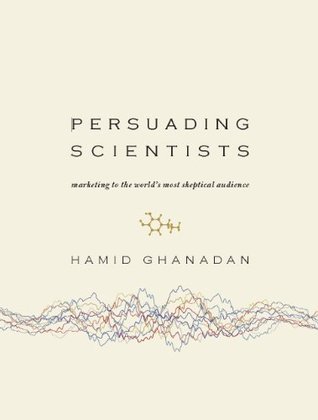
If you’ve ever worked at a bench, you know the experience well. A sales rep shows up, eager and polished, armed with brochures about their latest reagent or their new and improved version of something you already use. And somewhere in the back of your mind, you’re already running through your mental checklist, where’s the data? Has anyone actually validated this? Do I really need “new and improved” test tubes? I’ve been on the receiving end of that pitch more times than I can count, which is exactly why Persuading Scientists had been sitting on my TBR for a while. I finally picked it up, and I’m glad I did.
What This Book Is Actually About
Persuading Scientists is a guide for marketers and sales professionals working in the life sciences, specifically those trying to reach bench scientists as their customers. The author, Hamid Ghanadan, is a career life science marketer who has spent years helping biotech companies communicate more effectively with the researchers they’re trying to sell to.
Fair warning: the book was published in 2012, so some of the specifics are a little dated. But the core argument holds up. Ghanadan’s premise is that scientists are a fundamentally different kind of buyer, skeptical by training, data-driven by instinct, and deeply resistant to the kind of bold, unsubstantiated claims that might work on other audiences. If you want to sell to scientists, you have to think like one. That reframe is simple, but it’s more useful than it sounds.
What Got Me Thinking
Here’s the honest truth: coming from the bench, a lot of the advice in this book felt familiar, almost obvious. Of course scientists want to see data behind bold claims. Of course a free sample goes a long way. Of course having a knowledgeable representative available to answer questions builds trust faster than any brochure ever could.
But here’s what I didn’t expect, I didn’t have the language for any of it. I knew instinctively what worked and what didn’t when sales reps approached me in the lab, but Ghanadan gave me the framework to actually articulate why. That’s a different kind of useful. He walks through strategies like creating protocols for scientists to use on a company’s website, which simultaneously solves a real problem for researchers and positions the company as a leader in that area of research. It’s a small example, but it captures the book’s bigger point well: good science marketing isn’t about persuasion tricks. It’s about genuine utility.
For anyone working at the intersection of science and communication, whether that’s marketing, outreach, journalism, or advocacy, there’s something worth chewing on here. The same principles that make a biotech sales strategy work are the ones that make science communication land. Lead with evidence. Respect your audience’s intelligence. Make their lives easier, and the trust follows.
Why I Think You Should Read This
This is a 4/5 from me, not the most I’ve ever learned from a single book, but it earns its rating by being exactly what it promises: short, sharp, and to the point. There’s no padding, no unnecessary tangents. Every chapter gets in, makes its point, and gets out. I genuinely appreciate that kind of respect for the reader’s time.
If you’re considering a career in life science sales or marketing, I’d call this a must-read, it’s one of the clearest maps I’ve seen for understanding how scientists think as buyers and decision-makers. And if you’re already working at the bench or in science communication, it’s a worthwhile read for self-awareness alone. There’s something illuminating about seeing the strategies that were used on you, laid out clearly with the logic explained.
My Takeaway
The thing I keep coming back to is how much scientists underestimate their own influence as an audience. Entire marketing strategies are built around how we think, what we trust, and what makes us tune out. Understanding that doesn’t make you cynical, it makes you more intentional. Whether you’re on the receiving end of a pitch, building a science communication campaign, or thinking about how to make your research land with a broader audience, the underlying principle is the same: know your audience deeply, lead with evidence, and earn trust by being genuinely useful. That’s not just good marketing. That’s good communication, full stop.
Come Read Along
Have you read Persuading Scientists, or have a book like this that changed how you think about science and communication? I’d love to hear about it in the comments or over on Instagram.
And that’s a wrap on Science Reads 2024. What a year it has been. If you’re wondering what’s coming in 2025, I have a list, and it’s a good one. We’ll be diving into Challenger, the story of the space shuttle disaster and the institutional failures that caused it; The Kissing Bug, a deeply personal account of a neglected tropical disease; and The Catalyst by David Baker, fresh off his 2024 Nobel Prize in Chemistry. See you in the new year. 📚