
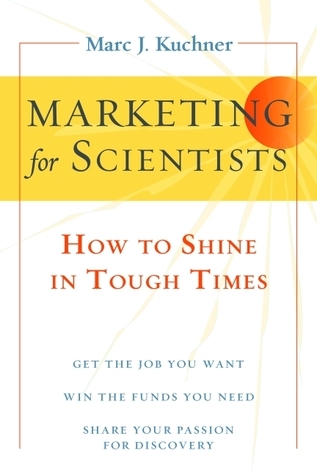
Bear with me. I know this isn’t the kind of book you might expect to see in Science Reads. There are no cells, no evolutionary biology, no sweeping histories of discovery. But I would argue, genuinely, not as a disclaimer, that this book belongs in the hands of every scientist at every stage of their career, and that the skills it covers are as essential to science as any technique you’ll learn in a lab. Give me a few minutes to make the case.
What This Book Is Actually About
Marketing for Scientists is Marc Kuchner’s practical, sometimes irreverent guide to something most scientists are never taught and rarely feel comfortable doing: marketing themselves and their work. Kuchner is an astrophysicist at NASA who became fascinated by the gap between great science and the ability to communicate and advocate for that science, and this book is his attempt to close it.
The core argument is straightforward: every scientist, regardless of field or career stage, will at some point need to sell their science. To a funding committee. To a hiring panel. To a journalist. To a room full of people who don’t share your background and need a reason to care. Kuchner’s book covers all of it, social media presence, talk structure, grant framing, handling rejection, with the practical specificity of someone who has thought deeply about why scientists struggle with this and what actually helps. Some sections are stronger than others, and there are tangential stories that you can feel free to skim. But the core of the book is genuinely useful, and I found myself returning to specific sections more than once.
What Got Me Thinking
The section that hit first, and hardest, was the one about selling your science. I’ll be honest: every time I hear the phrase “sell yourself,” something in me recoils. It sounds performative. It sounds like the opposite of the integrity that drew me to science in the first place. But Kuchner reframes it in a way I couldn’t argue with: selling your science is how you secure funding, how you land jobs, and how you get more people excited about what you’re doing. It’s not performance. It’s advocacy. That distinction matters, and once it clicked I found myself reading the rest of the book differently.
The social media chapter is one I think every scientist needs to read right now. Kuchner talks about a “neglected middle”, a large segment of the public that knows science exists but doesn’t know enough about it to make informed decisions using it. That’s the audience science communication is most urgently needed for, and social media is one of the most direct ways to reach them. His advice, build or update your website, get active on the platforms where your audience is, make connections with journalists so science gets portrayed accurately, is practical and specific and not nearly as daunting as it sounds once he breaks it down.
The talk structure advice is something I have genuinely used. Format your science talk like an action movie: open with a compelling hook, pull back to establish the broader context and why it matters, and then, don’t be afraid to get technical when the science demands it. The goal is to hold both the generalist and the expert in the room simultaneously, which is a harder balance to strike than it sounds. But having a framework for it makes the attempt feel manageable rather than impossible.
And then there’s the “what’s in it for me?” principle, the idea that every talk, every grant, every paper needs to answer that question for its audience before asking them to follow you into the details. Relate to your audience first. Give them a reason to care. The science will land so much better once they have one.
The reframe around rejection is the one I want to tape to my wall: rejection doesn’t mean you’re bad. It means you haven’t yet met someone’s particular needs. Find out what those needs are, and address them. That is a more useful and more accurate way to understand rejection than anything else I’ve heard, in science or anywhere else.
Why I Think You Should Read This
A full 5/5 from me, with the honest caveat that some of the author’s tangential stories are skimmable and a handful of sections should be taken with a grain of salt rather than accepted wholesale. But if you’re willing to engage critically and take what’s useful, this book offers more practical, career-shaping advice per page than almost anything else in this series.
Whether you’re just starting graduate school, mid-PhD, or already established in a research career, the skills this book covers are ones you will use constantly and that almost no formal scientific training prepares you for. That gap is real, and this book addresses it directly.
My Takeaway
The thing I keep sitting with is how much the scientific community has historically treated communication and marketing as somehow beneath the work, as if the quality of the science should speak for itself, and learning to advocate for it is a concession to something lesser. Kuchner’s book is a quiet but persistent argument against that view. The best science in the world doesn’t fund itself, doesn’t reach the public by accident, and doesn’t land in a job offer without someone making a compelling case for it. Learning to make that case isn’t a compromise of scientific integrity. It’s an extension of it, and arguably one of the most important skills we can build if we want science to have the influence on the world that it deserves.
Come Read Along
Have you read Marketing for Scientists, or do you have a book that changed how you think about communicating your work? I’d love to hear what helped you most. Drop it in the comments or find me on Instagram.
May’s Science Read is The Death and Life of the Great Lakes by Dan Egan, a story about one of the most extraordinary freshwater systems on the planet, and what we are doing to it. See you there. 📚