
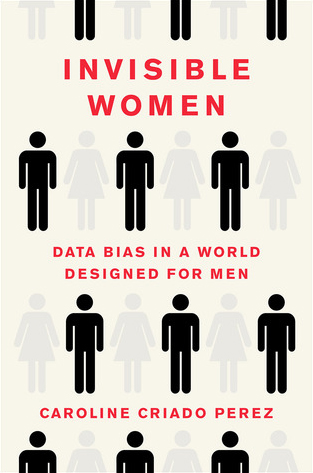
Yes, I’m really late with this one!! I did finish the book in March, but editing the YouTube review took it out of me 🥲
Rating ⭐️⭐️/5
What This Book Is Actually About
Invisible Women is Caroline Criado Perez’s argument that the world, its medicine, its infrastructure, its safety standards, its economic models, has been built around a default human template that is male. Not through deliberate malice, but through the quieter, more pervasive force of data gaps. When women aren’t included in clinical trials, when their bodies aren’t used to calibrate safety equipment, when their unpaid labor goes uncounted in economic data, the result is a world that treats half the population as an afterthought. The book moves across medicine, urban planning, crash testing, workplace design, and disaster relief, stacking case after case until the pattern becomes impossible to ignore.
Criado Perez is a journalist and feminist activist, and this is very much a journalist’s book, reported, specific, and genuinely enraging in the way that the best nonfiction is.
What Got Me Thinking
I tried to read this book three times. I started it halfway through my PhD and had to put it down. Tried the audiobook, same problem. Finally finished it with the physical copy, specifically because I could set it down and walk away when I needed to. That’s not a critique of the writing. That’s what it feels like to sit with this much accumulated evidence of being overlooked.
The example that has stayed with me hardest: when a woman is in a car crash, she is 47% more likely to be seriously injured than a man and 17% more likely to die, because crash test dummies are modeled on a 5’9″, 170-pound male body. That’s not an abstract policy failure. That is a design choice, made from a data gap, that costs lives.
But the section that reorganized something in my thinking was the gap inside the gap. Trans women don’t appear in this book. In a work explicitly about how failing to collect data on people renders them invisible, that is a painful irony the book doesn’t fully reckon with. Black women, disabled women, and women in the Global South are also significantly underrepresented. Criado Perez acknowledges this, she says she struggled to find disaggregated data. But that scholarship existed. Dorothy Roberts had been writing about medical racism and Black women’s health for decades before this book was published. The absence isn’t just a data problem. It’s a question of whose invisibility gets treated as the central story.
Why I Think You Should Read It
2/5, and I want to be precise about what that rating means. The information in this book is genuinely important, everyone should know it, and I believe everything she has written. I still had an extremely hard time getting through it, and not entirely for the reason the book intends. The argument works. The execution has real limitations, and those limitations matter most in a book whose entire thesis is about who gets left out.
It’s an important topic. I just think it could have been executed better.
My Takeaway
Data gaps are not neutral. Every time a researcher says “we didn’t have enough data on X group,” that absence has a history, it was built by choices, and it has consequences for real people. Criado Perez makes that case compellingly for women as a category. What I keep thinking about is how that same logic has to apply within the category, recursively, or you end up replicating the exact structure you set out to critique. Invisibility doesn’t stop at one layer.
April’s Science Read is Steve Jobs by Walter Isaacson, a complete tonal departure, but equally hard to put down. See you there. 📚