
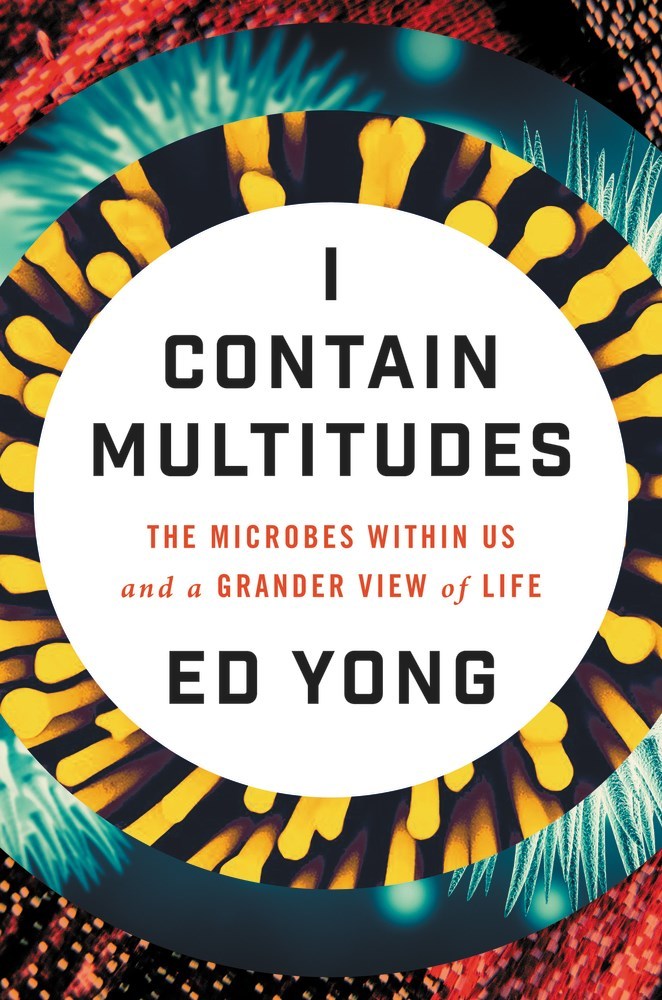
Quick gut check: when you hear the word bacteria, what’s your first instinct? If your brain immediately goes to illness, infection, something to be scrubbed away, you are in very good company, and you are also, it turns out, only seeing a tiny sliver of the actual picture. I went into I Contain Multitudes thinking I had a reasonably solid grasp of microbiology. I came out feeling like I had been looking at the world through a keyhole and someone had finally opened the door.
What This Book Is Actually About
I Contain Multitudes is Ed Yong’s exploration of the microbiome, the vast, astonishingly complex ecosystem of bacteria and other microbes that live in and on every living thing on Earth, including us. The title is the question as much as the premise: if roughly half of our cells aren’t even human, where exactly does “you” end and your microbiome begin?
Yong is a science journalist whose writing has the rare quality of making genuinely complex biology feel not just accessible but thrilling, the kind of writer who makes you feel the discovery alongside the scientists rather than simply being told what they found. In this book, he moves through the history of how humans first encountered, then largely misunderstood, then began to genuinely reckon with the microbial world, covering the research, the researchers, and the open questions that still remain at the frontier of microbiome science. It is, as he makes unmistakably clear, a frontier with an enormous amount of territory still unmapped.
What Got Me Thinking
The history alone is worth the price of admission. Microbes were first discovered in the 1600s by Antonie van Leeuwenhoek, a microscope maker who scraped plaque from his own teeth, put it under his lens, and found tiny living things moving about in extraordinary quantities. The problem was that no one else could build microscopes the way van Leeuwenhoek could, and so his discovery, extraordinary as it was, largely fell flat for nearly two centuries.
When microbes were effectively rediscovered around 1900, the scientists who picked up the thread focused almost exclusively on one thing: disease. Germ theory. The bad bacteria. That framework took hold so completely that it is still, more than a century later, the first thing most of us think when we hear the word bacteria. Yong makes you feel the weight of that historical accident, how a single, narrow entry point into the microbial world shaped an entire cultural instinct that we are only now beginning to correct.
The correction is long overdue. Every hour, each of us aerosolizes around 37 million bacteria. Our bodies are habitats, complex, dynamic ecosystems that microbes have co-evolved with for hundreds of millions of years, and in turn those microbes work to sustain us in ways we are only beginning to document. The Earth Microbiome Project, still ongoing, is attempting to take stock of every microbial species on the planet. The scale of what we don’t yet know is staggering.
The example that hit me hardest was hospitals. We sterilize everything, for good reason, to protect vulnerable patients from infection. But Yong’s framing recontextualized that practice in a way I couldn’t shake: “Sterility is a curse, not a goal. A diverse ecosystem is better than an impoverished one.” By eliminating the good bacteria alongside the bad, we may be inadvertently creating a more dangerous environment, one where harmful microbes face less competition, less resistance, less of the natural complexity that keeps them in check. The question isn’t how do we kill more microbes. It’s how do we protect the ones that are doing essential work while targeting the ones that cause harm. That reframe alone is worth the entire book.
Why I Think You Should Read This
Five out of five, and this is genuinely one of the books I recommend most readily to people who want to understand what modern biology actually looks like at its most exciting frontier. Yong takes science nonfiction and turns it into something that reads like an adventure novel, not by dumbing anything down, but by finding the human and narrative pulse inside the research and refusing to let go of it.
If you’ve ever taken a probiotic without being entirely sure what you were doing or why, if you’ve ever wondered what “gut health” actually means at a biological level, or if you’ve simply never thought much about the microbial world you’re constantly swimming in, start here. You will not look at your own body, or a hospital, or a forest floor, or a handful of soil the same way again.
My Takeaway
What I keep coming back to is how much our instinct to eliminate and sterilize, to see the microbial world purely through the lens of threat, has cost us in understanding. We built an entire cultural and scientific framework around a fraction of the picture, and then acted on that framework for over a century. The work of correcting it is ongoing and genuinely exciting, but it’s also a reminder that the stories we tell about science shape the science we do. Germ theory wasn’t wrong, it was incomplete. And the difference between those two things matters enormously when you’re deciding what to study, what to fund, and what to protect. Yong makes that argument without ever stating it directly, which is exactly what the best science writing does.
Come Read Along
Has this one shifted how you think about the microbial world, or did you already have a healthy appreciation for bacteria before picking it up? I want to hear where you started and where the book took you. Drop it in the comments or find me on Instagram.
March’s Science Read is Science Business by Gary Pisano, a completely different world from the microbiome, but just as essential if you’re trying to understand how science actually moves from a lab bench to the world. See you there. 📚