
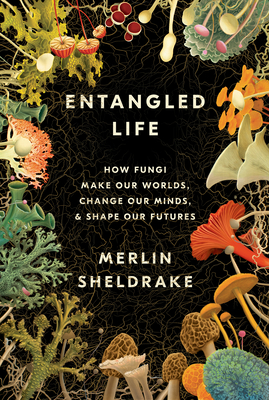
I am going to need you to do something before you read another word of this post. Go google Merlin Sheldrake. Right now. I’ll wait. Because the mental image of this man, who gives off full Harry Potter botanist energy in the most wonderful way imaginable, reading alongside his descriptions of crawling through forests and communing with fungi made this book an experience I was entirely unprepared for. I came in curious. I came out ready to become an amateur mycologist. I also came out wanting to rate this book a 6 out of 5, which tells you everything you need to know.
What This Book Is Actually About
Entangled Life is Merlin Sheldrake’s love letter to fungi, and love letter is genuinely the right phrase, because this book does not read like a scientific survey. It reads like someone who has spent their entire life obsessed with one of the most overlooked kingdoms of life on Earth finally getting to tell you everything, and barely being able to contain themselves while doing it.
Sheldrake is a biologist and researcher who has spent years studying mycorrhizal networks, the fungal webs that connect plants underground and shuttle nutrients, signals, and information between them. In Entangled Life, he moves through the full sweep of the fungal world: how fungi sense and respond to their environment, how they interact with plants, bacteria, and animals, how they have shaped ecosystems for hundreds of millions of years, and how radically they challenge our ideas about individuality, intelligence, and life itself. He also drops in Aldous Huxley’s Brave New World in the introduction, which meant I was fully on board before the first chapter even started.
What Got Me Thinking
Where do I begin. This book is full of the kind of facts that rewire something in your brain permanently. We carry more microbial cells than our “own” cells. There are more bacteria in the human gut than there are stars in the Milky Way. Fungi can edit and respond to their environment in ways that blur the line between behavior and biology. Octopuses feel alien, fungi feel like a different definition of life entirely.
But what got me thinking most deeply wasn’t any single discovery. It was the overarching theme Sheldrake returns to throughout the book: interconnectedness. Fungi don’t just branch outward, they merge, absorb, and fuse through processes like endosymbiosis. They act as ecosystem sensors, shape-shifting in response to change and facilitating communication between organisms that would otherwise have no way to reach each other. The question Sheldrake keeps circling, where does the individual end and the fungal network begin?, is one of the most genuinely destabilizing scientific questions I’ve encountered in a long time. It makes you look at a forest floor differently. It makes you look at yourself differently.
He also covers space mycology, fungi being used to break down oil spills and trash, the social and cultural history of yeast, and the strange, outsized power of truffles, and somehow all of it coheres into a single argument about the limits of how we’ve been trained to think about life. The most arresting passage in the book captures it perfectly: “Science isn’t an exercise in cold-blooded rationality. Scientists are, and have always been, emotional, creative, intuitive, whole human beings, asking questions about a world that was never made to be catalogued and systematized.” As a scientist and science communicator, I felt that in my chest.
Why I Think You Should Read This
Six out of five. That’s my rating and I’m standing by it. I have genuinely never read a book where the author’s love for their subject comes through with such authentic, almost child-like wonder, and I mean that as the highest possible compliment. Sheldrake doesn’t perform enthusiasm. He has it, completely and without apology, and it is contagious in the best possible way.
Read this if you love biology. Read it if you think you don’t. Read it if you’ve ever felt that science is cold or clinical or disconnected from the things that make life feel alive. This book is the antidote to all of that. And when you’re done, I promise you will want to go outside and look at every patch of moss, every rotting log, and every mushroom with entirely new eyes.
My Takeaway
The thing I’m still sitting with, weeks later, is Sheldrake’s portrait of science as an act of imagination. The idea that understanding fungi required researchers to imagine what they might be doing, to bring creativity and intuition into the lab alongside the data, challenges the clean separation we often draw between scientific rigor and human wonder. In science communication, I spend a lot of time thinking about how to make research feel alive for people who didn’t grow up in a lab. Sheldrake’s answer is simple and radical at the same time: let the wonder be visible. Don’t sand it down. The awe is the point, and it’s also, it turns out, part of how the best science gets done.
Come Read Along
Are you already a fungi person, or did this book make you one? I want to hear everything, drop your thoughts in the comments or come find me on Instagram. And if you end up going mushroom hunting after this, please tell me about it immediately.
March’s Science Read is The Beginning of Infinity by David Deutsch, a very different kind of book, and I’ll be honest with you about exactly how it went. See you there. 📚