
The comment I heard most during our Instagram Live discussion of this book was “an inspiring story.” And it is, genuinely, profoundly inspiring. But I want to be careful with that word, because I think “inspiring” can sometimes function as a way of smoothing over what Katalin Karikó’s story actually is: a decades-long account of a brilliant scientist being systematically underestimated, underfunded, demoted, and dismissed, and choosing, again and again, to keep going anyway. The inspiration is real. So is the injustice. And I think this book asks us to hold both at the same time.
What This Book Is Actually About
Katalin Karikó is one of the inventors of mRNA vaccine technology. She worked with BioNTech and Pfizer to develop the COVID-19 vaccine and was awarded the Nobel Prize in Physiology or Medicine in 2023, recognition that, for most of her career, would have seemed almost impossible to predict from the outside.
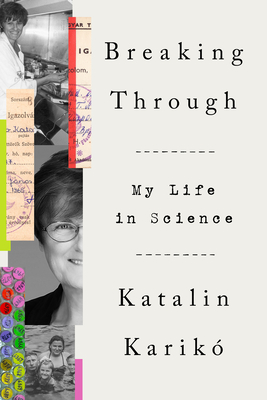
Breaking Through is her autobiography, and it traces her life from growing up in Hungary through decades of research in the United States that were marked far more by rejection and adversity than by recognition. A language teacher in high school who threatened to blacklist her from university. A government during her PhD that pressured her to spy on fellow researchers. Returning to work immediately after giving birth. A postdoc lab in the US that threatened deportation if she tried to move labs. Constant dismissal of her work on mRNA as a dead end, followed by demotion. Through all of it, she kept going. And as she writes it, with characteristic directness and zero self-pity, the question that hangs over every page is unavoidable: imagine where the world would be if she hadn’t.
What Got Me Thinking
This book is full of lines that I kept stopping to sit with, the kind that feel like they were written for a specific reader at a specific moment. “Sometimes bullshit men are lauded as heroes.” She writes it plainly, without elaboration, and it lands exactly as hard as it should.
But the insight I keep returning to most is her argument about how we measure scientific prestige. Karikó is direct: you are not a better scientist because you publish more or publish first. The best science takes time. And yet academia has spent decades conflating quantity of publications and citations with quality of work, creating a system that rewards speed and visibility over depth and rigor. She makes the case that we need clearer, better markers of what actually constitutes good science. As someone navigating academic spaces, I felt that argument somewhere very specific.
She also writes about science as cumulative, that when we celebrate the person who found the last piece of the puzzle, we are really celebrating everyone whose trustworthy, careful, often unrecognized work made that final piece possible. Karikó didn’t emerge from a vacuum. And neither does any discovery that changes the world.
The question she poses that I haven’t been able to shake: how do we find the people who are out there right now, today, doing important work that isn’t being recognized or supported? We can celebrate Karikó now. But she cannot be the only person in 1985 who made a breakthrough discovery that the system failed to see. How many others were lost? How many are being lost right now? That’s not a rhetorical question. It’s a structural one, and it deserves a structural answer.
And then there’s this: if we want women in science, we need an affordable, quality system of childcare. She doesn’t dress it up. She states it as plainly as any scientific finding, because it is one. The barriers keeping women out of science are not mysterious or inevitable. They are specific, addressable, and the result of choices we keep making as a society.
Why I Think You Should Read This
A full 5/5, and this is one I’d put in the hands of anyone in academia, anyone who has ever been told their work doesn’t matter, and anyone who thinks the systems around science are basically fair and just need minor tweaking. Karikó’s story is one that many women in STEM will recognize in pieces, maybe not as stark, maybe not as prolonged, but in the texture of it, in that low hum of having to prove yourself in spaces that were never quite designed with you in mind.
Read it for the inspiration, absolutely. But read it also for the clarity it brings about what needs to change, and what we lose when we don’t change it.
My Takeaway
What I’m still carrying from this book is the weight of all the science we will never know about. The discoveries that were never made because the person who would have made them was pushed out, defunded, deported, or simply worn down by a system that couldn’t see them. Karikó survived all of that and changed the world anyway. That is extraordinary, and it should also make us furious that it had to be extraordinary at all. The goal isn’t a world where a few exceptional people overcome every obstacle placed in front of them. The goal is a world where the obstacles aren’t there in the first place. Her story is the inspiration. That question is the work.
Come Read Along
Did you join us for the Instagram Live discussion of this one? I’d love to keep the conversation going, drop your thoughts in the comments or find me on Instagram. And if her story resonated with you in a specific way, I really want to hear it.
February’s Science Read is Entangled Life by Merlin Sheldrake, and I’m going to need you to google the author before you do anything else. See you there. 📚