
Okay. I have a confession to make. This is my first ever DNF, Did Not Finish, in the history of Science Reads. I know, I know. I tried. I really did. I read the first two chapters, hit a wall, reached out for guidance on which chapters were worth pushing through, read those, and still found myself staring at the pages wondering how I got here. So let’s talk about it, because I think there’s something worth saying even when a book doesn’t land for you.
What This Book Is Actually About
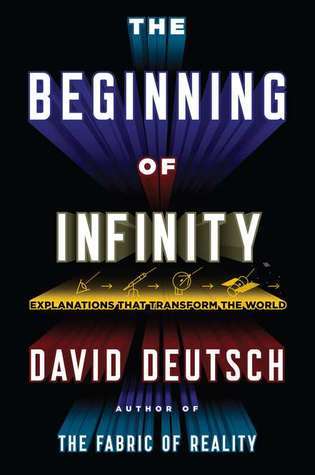
The Beginning of Infinity is written by David Deutsch, a physicist who pioneered the field of quantum computation, he formulated one of the foundational descriptions of the quantum Turing machine and specified an algorithm designed to run on a quantum computer. That is an extraordinary scientific résumé, and going in, I expected this to be a science book in the way I understand science books.
It is not, really. It is a philosophy book. The science woven through it touches on space, multiple dimensions, and how we perceive and explain reality, and Deutsch’s central argument is that human knowledge and understanding have no fundamental limits, that we are at the beginning of an infinite capacity for explanation and growth. It’s a sweeping, ambitious premise. The execution, though, is heavily philosophical, long stretches of Deutsch offering his own opinions and frameworks rather than grounding arguments in concrete, observable evidence. For some readers, that’s exactly what makes it compelling. For me, it’s where I kept losing the thread.
What Got Me Thinking
Here’s something I genuinely learned about myself from this book: I have a very hard time engaging with science I can’t physically see, touch, or connect to something tangible. Cells? Absolutely. Fungi, vaccines, technology, animal behavior, sign me up. But space, multi-dimensions, and abstract theories of reality? My brain resists in a way I hadn’t fully recognized before. That’s not a criticism of the subject, it’s just honest self-awareness, and I think it’s worth naming because it shaped everything about how I experienced this book.
The chapters I did read, The Reach of Explanation, Optimism, A Dream of Socrates, Choices, Why Are Flowers Beautiful, The Evolution of Creativity, gave me enough to work with. And there were moments. Deutsch’s argument that our understanding of the future is fundamentally limited by the boundaries of our current knowledge, and that those boundaries will keep shifting as we learn more, is a genuinely interesting idea, and one I agreed with. It’s the kind of optimism about human inquiry that resonates with me.
But then there’s an entire chapter structured as a dialogue between Socrates and Hermes. And a chapter making the case for the objective truth of beauty. And somewhere in there I kept losing him, not because the ideas are bad, but because the philosophical mode of argument, opinion layered on opinion without the grounding of data or observable evidence, is simply not how my brain wants to receive ideas. I need the anchor. Without it, I drift.
Why I Think You Should Read This
One star from me, and I want to be clear that this is entirely a reader-book mismatch, not a verdict on Deutsch’s intellect or ambition. If philosophy is your natural register, if you find multi-dimensional thinking and abstract frameworks about knowledge and reality genuinely exciting, I think you’ll love this. It is clearly a book that means a great deal to the people it resonates with.
But if you’re coming to Science Reads expecting the kind of book that grounds big ideas in tangible, visible science, the kind that makes you feel like you’re discovering something you can hold, this one may frustrate you the way it frustrated me. Go in knowing what it is: a philosophy book first, a science book second.
My Takeaway
Honestly? The most valuable thing this book gave me was clarity about how I learn. Knowing what doesn’t work for you is just as useful as knowing what does, maybe more so. As a science communicator, I think about this a lot: the way an idea is framed, the mode it arrives in, the sensory and cognitive hooks it offers, all of that determines whether it lands. Deutsch has genuinely important ideas in this book. But ideas still need to meet their audience where they are. That’s not the reader’s failure. It’s the contract of communication. And this month, for me, that contract didn’t quite hold up its end.
Onto the next one, and hopefully a much better match.
Come Read Along
Have you read The Beginning of Infinity? I genuinely want to hear from you if you loved it, I’m curious what clicked for you that didn’t click for me. Drop it in the comments or find me on Instagram. No judgment, only book talk.
April’s Science Read is Secrets of the Octopus by Sy Montgomery, and I promise, we are back to biology and I am back to being fully obsessed. See you there. 📚