
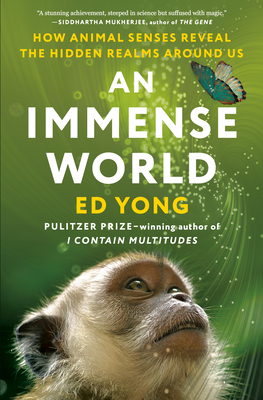
If you ever want to feel both humbled and completely electrified by the natural world in the span of a single book, this is the one. I’ll be honest, when I heard Ed Yong had written a book covering the entirety of animal sensory diversity, I was skeptical. That’s an enormous canvas. The kind of scope that usually ends in a book that feels rushed, or shallow, or like it’s trying to do too much. I was wrong. Completely, happily wrong.
What This Book Is Actually About
An Immense World is built around a single, beautiful concept: Umwelt, the idea that every organism experiences the world through its own unique sensory reality. The world as a dog smells it, as a bat hears it, as a mantis shrimp sees it, is not the world as we experience it. Each creature is living inside its own sensory universe, and we have almost no instinctive access to any of them.
Ed Yong, science journalist, Pulitzer Prize winner, and genuinely one of the best science writers alive, takes that concept and unpacks it sense by sense. Pain, light, heat, sound, electric fields, magnetic fields. He walks through the experiments behind each discovery, the researchers who dedicated their careers to understanding how other animals perceive reality, and, crucially, how much we still don’t know. Did you know that so many animals can sense magnetic fields, yet it remains the only sense without a known sensory receptor? That single fact has lived in my head rent-free since I read it.
What Got Me Thinking
Every scientist should read Ed Yong, not just for the science, but to study how he writes it. The way he constructs a narrative around research, makes you feel the discovery alongside the scientists, and never once lets the complexity become a barrier, that’s the gold standard of science communication. Creating a story with the science, not just about it. This book is a masterclass in exactly that.
The footnotes alone are worth the read. Half of my notes on this book came straight from the highlights I made there. My personal favorite, his comparison of the army ant death spiral to the US pandemic response on page 31, had me laughing out loud and then immediately feeling a little too seen. That’s the Yong signature move: sneak a profound observation into a parenthetical and walk away.
I also couldn’t help but let my mind wander while reading the sections on electric fields, magnetic navigation, and the jaw-dropping sensory world of the naked mole rat (that chapter is genuinely a hoot). I’d recently finished Blake Crouch’s sci-fi novel Upgrade, which imagines a future where human senses are biologically enhanced, and the two books kept colliding in the best way. From the giant squid to the naked mole rat, Yong lays out a menu of sensory possibilities that makes Crouch’s premise feel less like fiction and more like an earnest research proposal. If you’re a sci-fi reader, read them back to back. You’ll thank me.
And then there’s the question Yong closes with, one that I think every scientist and science communicator should be sitting with: how is humanity affecting the sensory worlds of other animals? Light pollution disrupting navigation. Noise pollution interfering with communication. Our presence quietly rewriting the sensory landscapes that other species depend on. It’s the kind of question that makes you look at the world differently on the way out than you did on the way in.
Why I Think You Should Read This
This is a full 5/5, no hesitation. Get this for your scientist friends. Get it for your friends who think they don’t like science, because this book will change their minds. Yong has a gift for making you feel the wonder of a discovery without ever dumbing it down, and An Immense World might be the purest expression of that gift I’ve encountered.
If you haven’t read Yong before, I’d actually suggest starting with his first book, I Contain Multitudes, about the microbial world living inside and around us. It will calibrate your appreciation for his voice so that when you get to An Immense World, you can feel exactly how much further he’s taken it.
My Takeaway
What I keep coming back to is the sheer, generous scale of the unknown. Yong doesn’t just show you what we’ve discovered about animal senses, he shows you the edges of what we don’t yet understand, and makes those edges feel like invitations rather than frustrations. That’s rare. In science communication, we often feel pressure to package things neatly, to land on answers. But some of the most powerful things we can do is show people the open questions and make them feel exciting rather than unsettling. Yong does this better than almost anyone. Walking away from this book, I felt smaller in the best possible way, and far more curious about the world humming away just outside the range of my very human senses.
Come Read Along
Has a book ever completely recalibrated how you move through the world? Because this one did that for me. I’d love to know what landed for you, drop your thoughts in the comments or come find me on Instagram.
July’s Science Read is Playing with Reality by Kelly Clancy, a neuroscientist and physicist exploring how games have shaped the way we think and reason. A very different world from animal senses, but just as fascinating. See you there. 📚