
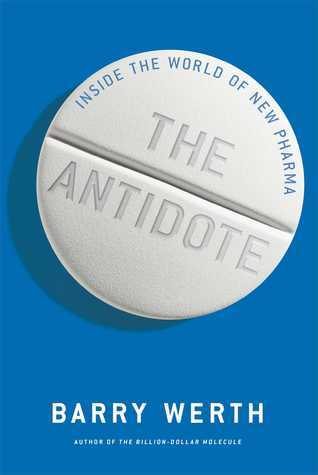
I want to start by saying I genuinely tried. I tried twice, actually, because I started with The Antidote, the second book, thought maybe I was just disoriented from missing the context of the first, went back and read A Billion Dollar Molecule, and then returned to finish The Antidote with fresh eyes. Reader, it did not help. These two books have a genuinely fascinating story at their center, and somehow managed to make it feel like sitting through a very long meeting you weren’t supposed to be in.
What These Books Are Actually About
Barry Werth’s two-book series documents the rise of Vertex Pharmaceuticals, a company founded in 1989 by Joshua Boger that became one of the first to use rational drug design as its core strategy. Instead of tweaking existing molecules borrowed from nature, the way most pharmaceutical companies operated at the time, Vertex designed specific molecules from the ground up. That distinction matters, and it was genuinely radical when Boger launched the company into a field dominated by giants who thought a startup with that approach couldn’t possibly sustain itself.
A Billion Dollar Molecule, published in 1994, covers Vertex’s early years, the competition with Merck on immunosuppressants, the scramble for funding, the culture of a company trying to prove its model before the industry closed the door on them. It ends with progress but no finished molecule, and Vertex just entering clinical trials for an HIV drug. The Antidote, published twenty years later in 2014, picks up the thread, following Vertex through to the development of Incivek, the first effective Hepatitis C treatment, in 2011, and Kalydeco, a drug that meaningfully improved the lives of a subset of cystic fibrosis patients, in 2012. The science at the heart of both books is genuinely worth knowing about. The execution, unfortunately, is a different story.
What Got Me Thinking
Vertex is a cool story. I want to say that clearly, because my issues with these books are about the writing, not the subject. A small company using a fundamentally different scientific approach to take on established pharmaceutical giants, and winning, eventually, with drugs that genuinely changed lives, is exactly the kind of story science communication should be telling more of.
The rational drug design strategy Boger built Vertex around represents a real shift in how the industry thought about molecule discovery, and the development of Kalydeco in particular, targeting a specific genetic mutation in cystic fibrosis patients, is a landmark moment in precision medicine. That story deserves to be told compellingly. I just don’t think these books quite manage it.
What Werth does instead is spend page after page on stock valuations, conference room politics, and the biographical backgrounds of a character list so extensive it becomes genuinely impossible to track. Snippets of the actual science appear occasionally, almost haphazardly, sandwiched between ten-page breakdowns of board meeting dynamics and drug pipeline tangents about molecules that never made it through development. I read these books for the science. The science kept getting buried.
The structural problem in both books is the same: it reads like someone taking thorough notes in real time without stepping back to find the thread that connects them. Individual scenes exist. A cohesive narrative, one that makes you feel the momentum of what Vertex was building toward, never quite materializes.
Why I Have Mixed Feelings Recommending This
Three out of five, and that rating is almost entirely carried by how interesting Vertex’s actual story is, not by how well it’s told here. If you work in pharmaceutical development, biotech, or drug discovery and want an insider account of what building a company like Vertex actually looked like from the inside, there is value here. The details Werth captures, the competitive intelligence, the investor dynamics, the specific scientific gambles Boger made, are real and hard to find elsewhere.
But if you’re coming to this as a science reader looking for the kind of narrative that makes you feel the discovery, the way The Song of the Cell or Bad Blood does, this is likely to frustrate you. The bones of a great book are here. They just needed a different architect.
My Takeaway
What I keep thinking about after these two books isn’t actually anything from the text itself, it’s the gap between a great story and great storytelling. Vertex’s journey from scrappy rational-design startup to the company that developed a working cystic fibrosis treatment is the kind of story that should make you feel something. It involves real scientific courage, real competitive pressure, and real patients whose lives changed because of what this team built. That story exists in these books. It’s just buried under too much noise to fully land. And that, more than anything, is a reminder of what science communication is actually for, not just to document what happened, but to make you understand why it matters.
Come Read Along
Have you read either of these, or do you know the Vertex story from another angle? I’d genuinely love to hear a take from someone who loved them, because I think the subject matter deserves better than my 3-star experience of it. Drop it in the comments or find me on Instagram.
September’s Science Read is The Six by Loren Graham, the story of six Russian scientists whose discoveries changed the world, and what the Soviet system did to them in return. A completely different kind of science story, and one I have been thinking about ever since I finished it. See you there. 📚