
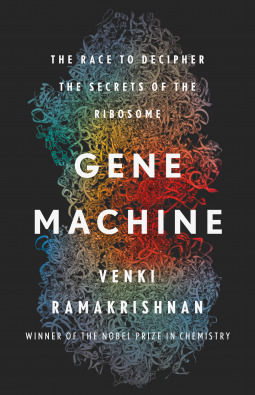
I picked this one up on a whim. No particular reason, no recommendation, just a Nobel laureate’s name on a cover and a curiosity about ribosomes that I hadn’t realized I had until I was already three chapters in and completely hooked. Gene Machine did something I didn’t know I needed it to do: it made me fall in love with science research again. Not the polished, retrospective version of science where breakthroughs arrive cleanly and credit flows to the right people. The real version, messy, competitive, lucky, collaborative, and endlessly more interesting than the heroic narrative we usually tell about it.
What This Book Is Actually About
Gene Machine is Venki Ramakrishnan’s account of the race to determine the structure of the ribosome, the molecular machine responsible for translating genetic code into proteins, present in every living cell, and one of the most complex and consequential structures in biology. Ramakrishnan shared the 2009 Nobel Prize in Chemistry for this work, alongside Ada Yonath and Thomas Steitz.
But the book is less about the Nobel Prize than about everything that had to happen before it, and more importantly, about dismantling the idea that a Nobel Prize represents one person’s singular genius finally receiving its due. Ramakrishnan is unusually, refreshingly honest about how science actually works: the false starts, the competition, the moments of luck that shaped the outcome as much as any insight, and the many people whose work made his own possible. He writes with the specific authority of someone who was inside the race and has spent years thinking carefully about what it actually meant.
What Got Me Thinking
The line that I keep returning to is the one Ramakrishnan offers almost as an aside: “I don’t subscribe to the heroic narrative of science. Rather, some of us are fortunate enough to be the agents of important discoveries that would have been made anyway, sometimes not even that much later.” That sentence is doing an enormous amount of work. It is honest in a way that scientists rarely allow themselves to be publicly, and it reframes every Nobel Prize announcement, every landmark paper, every “eureka moment” story we tell about scientific progress.
The race to determine the ribosome structure involved dozens of labs, competing and collaborating in shifting configurations, sharing data when it was advantageous and guarding it when it wasn’t, making breakthroughs that built on predecessors who sometimes received far less credit than the work warranted. Sound familiar? It should, it is how almost all of the most important science in history has actually happened, and the gap between that reality and the story we tell about it has real consequences for how young scientists understand what they’re walking into.
The takeaways Ramakrishnan pulls from the experience are the kind that stick: always ask why you’re doing what you’re doing. No question is too basic to be worth asking. The biggest breakthroughs tend to come from the intersection of multiple fields, Ramakrishnan himself came to crystallography through physics and basic biology, and that combination of lenses was part of what made his approach distinctive. Advancing science requires not just better techniques but easier ones, accessibility matters as much as capability. And the grant system, for all its apparent fairness on paper, can be deeply arbitrary when it comes to risky or original proposals. Ramakrishnan worked on the ribosome project as a side project for years because he didn’t think it would get funded as a primary focus. The Nobel Prize-winning work was, for a significant stretch, a gamble he was running in his spare time.
The section on scientist fame is one I’ve been thinking about since I put the book down. The way public recognition distorts our picture of what science looks like, concentrating credit on a small number of famous names while making invisible the collaborative, cumulative, luck-dependent nature of the actual work, is a science communication problem as much as anything else. The stories we tell about science shape who believes they belong in it. And the heroic lone genius narrative excludes, by design, most of the people who actually make science happen.
Why I Think You Should Read This
A full 5/5, and if last month’s The Code Breaker gave you the story of CRISPR through Doudna’s eyes, Gene Machine is a perfect companion: another Nobel laureate, another foundational discovery, and a completely different, and I’d argue even more honest, perspective on how these moments actually come to be. Read them together and you’ll come away with a much fuller picture of what scientific discovery looks like from the inside.
Ramakrishnan is funny, self-aware, occasionally sharp about his competitors in ways that feel entirely earned, and consistently generous toward the people whose work made his possible. That combination makes this one of the most readable and trustworthy accounts of modern science I’ve encountered in this series.
My Takeaway
The image that has stayed with me is the one Ramakrishnan uses for scientific progress: not a summit you climb toward, but a series of foothills, each discovery building on the previous, each new vantage point revealing more terrain ahead rather than less. There is no finishing line. There is no complete understanding waiting at the top. There is only the next question, made possible by the answer you just found. That framing is both humbling and energizing in equal measure, and it is, I think, the most honest thing you can say about what a scientific career actually is. Not a march toward mastery. A willingness to keep climbing, knowing the view will always open onto more.
Come Read Along
Has a book ever made you fall in love with research again when you needed it most? I’d love to hear what it was, drop it in the comments or find me on Instagram. And if you’re a scientist who has ever felt like the heroic narrative of science didn’t quite match your experience of actually doing it, this book will feel like a conversation with someone who gets it.
December’s Science Read is The Metaverse by Matthew Ball, a complete departure from the lab, but one of the most consequential questions about where we are all headed. A fitting way to close out a year of reading. See you there. 📚