
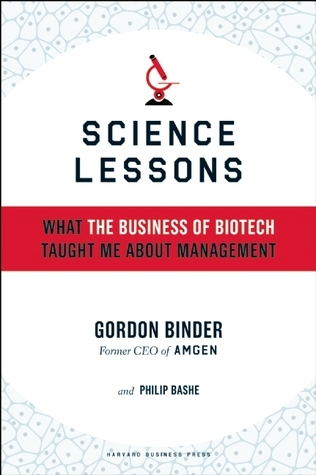
A recommendation from a trusted person is a different kind of book discovery. When Susanna Harris told me to read this one, I picked it up already predisposed to pay attention, and it delivered on every page. Science Lessons is the kind of book that makes you wish more people who have built extraordinary things would sit down and write honestly about how they actually did it.
What This Book Is Actually About
Science Lessons is the autobiography of Gordon Binder, former CEO of Amgen, a company widely regarded as one of the most successful and innovative biotechnology companies ever built. But calling it just an autobiography undersells what it actually is: a behind-the-scenes look at what it genuinely takes to build a biotechnology company from the ground up, told by someone who lived through every stage of it.
Binder writes at the intersection of science and business with the authority of someone who has navigated both, and the book is useful far beyond the narrow audience of people who want to start their own biotech firm. Anyone who wants to understand how biotechnology actually operates, the economics, the culture, the decision-making, the values, will find something here. The specifics of Amgen’s story are fascinating on their own terms. The principles Binder pulls from that story are the kind that transfer across industries, career stages, and organizational scales.
What Got Me Thinking
The numbers Binder opens with set the stakes immediately: roughly 500 promising agents for every one that makes it to market. Nine to twelve years of development. An industry that hemorrhages money for most of that time before a single product generates revenue. Understanding that math, really sitting with it, reframes every conversation about drug pricing, biotech investment, and the pace of medical progress. It doesn’t make the outcomes of that system always defensible, but it makes them comprehensible in a way that matters for having honest conversations about it.
The management philosophy woven through the book is where I found myself underlining the most. The argument that large companies work best with decentralized management and genuine trust in employees and local decision-making runs counter to the instinct many leaders have to maintain control as an organization scales. Binder makes the case convincingly, and Amgen’s history is the evidence. The point about surveying employees for the values they want in the company, rather than handing down values that leadership wrote and asking employees to embody them, is one I’d put in front of every organization that has ever laminated a list of core values and stuck it on a wall without asking anyone who works there what they actually believe.
The hiring principle is equally sharp: a great scientist who doesn’t believe in the company’s values will be a bad employee. That sounds obvious until you’re in the room where the hiring decision is happening and the candidate has an extraordinary CV. And then there’s the one that I think about beyond just biotech: an A+ management team with an average B plan will outperform an A+ plan with an average management team. Every time. The people executing the plan matter more than the plan itself. That’s a truth that good science communication, good research, and good organizations all share.
The emphasis on PhDs throughout the book also resonated in a specific way. Binder argues clearly that science businesses should not undervalue the skills of researchers, experiment design, troubleshooting, comfort with uncertainty, the ability to ask the right question before committing to an answer. Those skills are directly applicable to business decision-making, and organizations that treat their scientists as technical operators rather than strategic thinkers leave an enormous amount on the table.
Why I Think You Should Read This
A full 5/5, and a genuine thank you to Susanna Harris for putting this in my hands. Whether you’re a scientist thinking about industry, someone building or working inside a biotech company, or simply curious about how one of the most extraordinary companies in the history of the field actually got built, this book is worth your time. Binder writes with clarity and without self-congratulation, which is rarer in CEO memoirs than it should be. The honesty about what was hard, what failed, and what had to be rebuilt is what makes the success story actually instructive rather than just impressive.
My Takeaway
The principle I keep coming back to is the one about being science-based and people-based simultaneously, and specifically the advice that if a team believes in a product, that belief should factor into the decision about whether to continue pursuing it. That’s not anti-scientific. It’s a recognition that the people closest to the work often have information the data alone doesn’t capture, intuitions built from deep familiarity, pattern recognition developed over years of working a specific problem. Good science and good management both require knowing when to trust the numbers and when to trust the people reading them. Binder’s book is one of the most practical explorations of that balance I’ve found.
Come Read Along
Have you read Science Lessons, or do you have a biotech memoir or business book that changed how you think about the intersection of science and industry? Drop it in the comments or find me on Instagram. And a special thank you again to Susanna Harris for this recommendation, this is exactly the kind of book this series exists to find. 🫶
September’s Science Read is The Code Breaker by Walter Isaacson, the story of Jennifer Doudna, CRISPR, and the race to rewrite the code of life. It is one of the most consequential scientific stories of our time, and I have been saving it for the right moment. See you there. 📚