
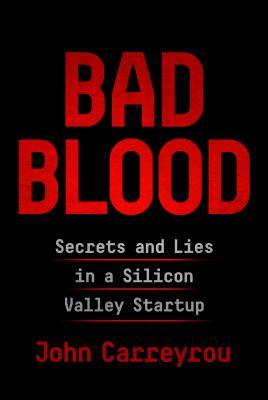
If you watched Hulu’s The Dropout and found yourself oscillating between fascination and fury, first of all, same. Second of all, put this book at the top of your list immediately, because the full story is even more staggering than the show had time to tell. Bad Blood is where it started, and it is one of the most important books about science, ethics, and institutional failure I have read in this entire series.
What This Book Is Actually About
Bad Blood is Wall Street Journal investigative journalist John Carreyrou’s account of Elizabeth Holmes and Theranos, the company she founded at nineteen after dropping out of Stanford, built on a single audacious claim: that a drop of human blood could be used to diagnose hundreds of different diseases and medical markers, faster and cheaper than any existing technology.
Theranos raised over $700 million dollars on that claim. It attracted some of the most powerful names in American business and politics to its board. It secured partnerships with major companies including Walgreens, who deployed Theranos testing centers in their stores across the country. And the technology, it turned out, didn’t work. The machines were error-prone and nowhere near market-ready. The company regularly diluted blood samples and ran them on other manufacturers’ equipment while telling patients and partners they were using their own proprietary technology. The results were wildly inaccurate. And thousands of patients made real, life-altering medical decisions based on those results.
Carreyrou broke the story after a series of whistleblowers came to him at enormous personal and professional risk, employees who had watched what was happening inside Theranos and couldn’t stay silent any longer. This book is the full account of what they told him, and what he found when he kept pulling the thread.
What Got Me Thinking
The science fraud at the center of this story is enraging on its own terms, as a scientist, there is something viscerally wrong about watching fabricated data presented as breakthrough research to investors, regulators, and clinicians who had no reason to doubt it. But what makes Bad Blood more than just a fraud story is the patient dimension. This wasn’t a company misleading investors about future profits. It was a company providing inaccurate diagnostic results to real people making decisions about cancer treatment, medication dosages, pregnancy, and other irreversible health choices. The gap between what Theranos claimed and what it delivered wasn’t an inconvenience. It was a direct threat to human health.
The dilution problem is the detail that has stayed with me longest. When you dilute a blood sample to run it through an assay, you lower the concentration of every analyte you’re measuring. Every result comes back artificially low. A patient with dangerously elevated levels of something might receive a result that looks normal. A patient who needs intervention might be told everything is fine. And none of them had any reason to know the test they just received was built on a methodology that made accurate results almost impossible.
What allowed this to continue for over a decade is the question Carreyrou keeps returning to, and the answer involves a failure at every level of the system that was supposed to catch exactly this kind of fraud. Investors who were dazzled by the story and didn’t ask hard enough questions about the data. Regulators who were navigated around through a combination of legal maneuvering and aggressive intimidation of anyone who raised concerns. Board members with enormous prestige and almost no scientific background. And a culture, Silicon Valley’s specific brand of “fake it till you make it”, that treated overpromising not as fraud but as vision.
Why I Think You Should Read This
A full 5/5, and not just as a gripping true crime story, which it absolutely is. This book is a case study in why understanding the science behind a discovery is not optional for the people making decisions about it. Holmes was able to operate for as long as she did in part because the people around her, investors, partners, board members, didn’t have the scientific literacy to evaluate her claims critically. That is not a personal failing. It is a systemic one, and it is one that science communication has a direct role in addressing.
If you haven’t watched The Dropout, read this first. If you have, read this anyway, the book goes places the show doesn’t have time to, and Carreyrou’s reporting is meticulous in a way that makes the whole story feel even more extraordinary.
My Takeaway
What I keep sitting with is the whistleblowers. The people who saw what was happening inside Theranos, understood what it meant for patients, and chose to come forward despite knowing exactly what it would cost them professionally and personally, those are the people this story ultimately belongs to. Science integrity doesn’t maintain itself. It is maintained by individual people making difficult choices, often without institutional support, to say out loud that something is wrong. That is not a comfortable truth. It is also one of the most important ones. And every scientist who reads this book should ask themselves what they would do in the same position, because the circumstances that produced Theranos were not unique to one company or one industry. The pressures that bent the science there exist everywhere science and money intersect.
Come Read Along
Have you read Bad Blood or watched The Dropout, and did one change how you saw the other? I’d love to hear your take in the comments or on Instagram. This is one of those stories that sparks a different reaction depending on whether you’re coming to it as a scientist, an investor, a patient, or just a person who finds institutional failure endlessly fascinating.