
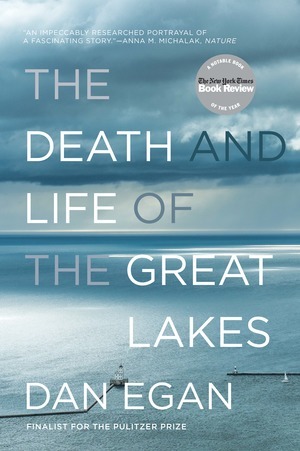
Growing up in Minnesota, Lake Superior was just, there. One of more than 10,000 lakes in the state, enormous and freezing and always present. My family would go camping by it, and we’d see who could last the longest walking into the water. I always lost. I was also, I can see now, completely taking for granted one of the most extraordinary freshwater systems on the planet. This book fixed that. It also made me a little angry, which I think was entirely the point.
What This Book Is Actually About
The Great Lakes span five states and two Canadian territories, and together they contain over 20% of all the freshwater on Earth. Twenty percent. Of all the freshwater on the entire planet, sitting in these five lakes that generations of people who live near them have treated as a permanent, inexhaustible given. The Death and Life of the Great Lakes is investigative journalist Dan Egan’s account of what we have done to them, and what we are not doing nearly enough of to protect what remains.
Egan spent years reporting on the Great Lakes for the Milwaukee Journal Sentinel, and that depth of reporting shows in the book. This isn’t an overview. It’s a granular, specific, sometimes infuriating examination of the decisions, policy, economic, ecological, that have accelerated the degradation of these lakes over the past century. He moves through the history, the current crisis, and the measures that exist or could exist to address it, with the precision of someone who has spent a long time understanding exactly where the system is failing and why.
What Got Me Thinking
The scale of the ecological damage Egan documents is staggering, and what makes it particularly hard to sit with is how much of it was entirely preventable, the result of specific human choices made for specific short-term reasons, without serious consideration of long-term consequence.
We built unnatural seaways connecting the lakes to the ocean, which increased outflow and fundamentally altered the hydrology of the system. Cargo ships brought invasive species in their ballast water, reshaping ecosystems that had no defenses against them. And then, the one that genuinely stopped me, we deliberately introduced invasive species like Chinook Salmon to create better sport fishing, decimating the native fish populations in the process. We introduced the problem ourselves, for recreation. The Phosphorus runoff from agricultural fertilizer triggers massive toxic algae blooms annually, and rising lake temperatures from climate change are accelerating evaporation and causing water level fluctuations that cascade through every connected ecosystem.
The response to all of this has been, and Egan is unflinching about this, not enough. The EPA requires incoming sea freighters to wash their ballast chambers of potentially invasive ocean water, but many vessels are currently exempt. Electric fences exist to prevent some invasive species from entering the lakes, but fish still swim through. Phosphorus limits are in place but insufficiently enforced. The gap between what is being done and what the scale of the problem demands is enormous, and Egan doesn’t let the reader look away from it.
What could change things? Tighter regulations on sea freighters with no exemptions. Real restrictions on invasive fish pathways through connecting rivers. More aggressive prevention of toxin runoff. And breeding programs to reintroduce native fish species into lakes where they have effectively been displaced. The solutions exist. The political and economic will to implement them is the missing ingredient, which is, in some ways, the oldest story in environmental science.
Why I Think You Should Read This
A 4/5 from me, and the missing star is less about any flaw in the book and more about the fact that Egan’s thoroughness occasionally tips into density that slows the momentum. He is an investigative journalist at heart, and the book reads that way: comprehensive, well-sourced, and in some stretches more exhaustive than the narrative strictly requires.
But the subject matter is urgent in a way that I don’t think gets nearly enough mainstream attention. In a world where freshwater availability is decreasing globally and becoming one of the defining resource challenges of the coming century, the fact that 20% of the planet’s surface freshwater sits in five lakes that we are actively degrading should be front-page news every year. Egan makes that case better than anyone I’ve read.
My Takeaway
I grew up walking into Lake Superior and complaining about how cold it was. I had no idea what I was standing next to. That’s the thing about resources we inherit, we don’t tend to understand their value until we start to lose them. The Great Lakes aren’t lost yet. The science exists to protect them. The policy tools exist. What Egan’s book makes devastatingly clear is that existing isn’t the same as being used, and that the gap between what we know and what we do is where most environmental damage actually happens. Science communication, at its most important, is about closing that gap. Making people feel, as viscerally as possible, what is actually at stake. This book does that. I hope it reaches the people who need to read it most.
Come Read Along
Have you ever been to the Great Lakes, or grown up near a body of water you took for granted until you learned more about it? I’d love to hear about it in the comments or on Instagram. And if this one sparked any urgency around freshwater conservation for you, that’s exactly the reaction Egan was going for.