
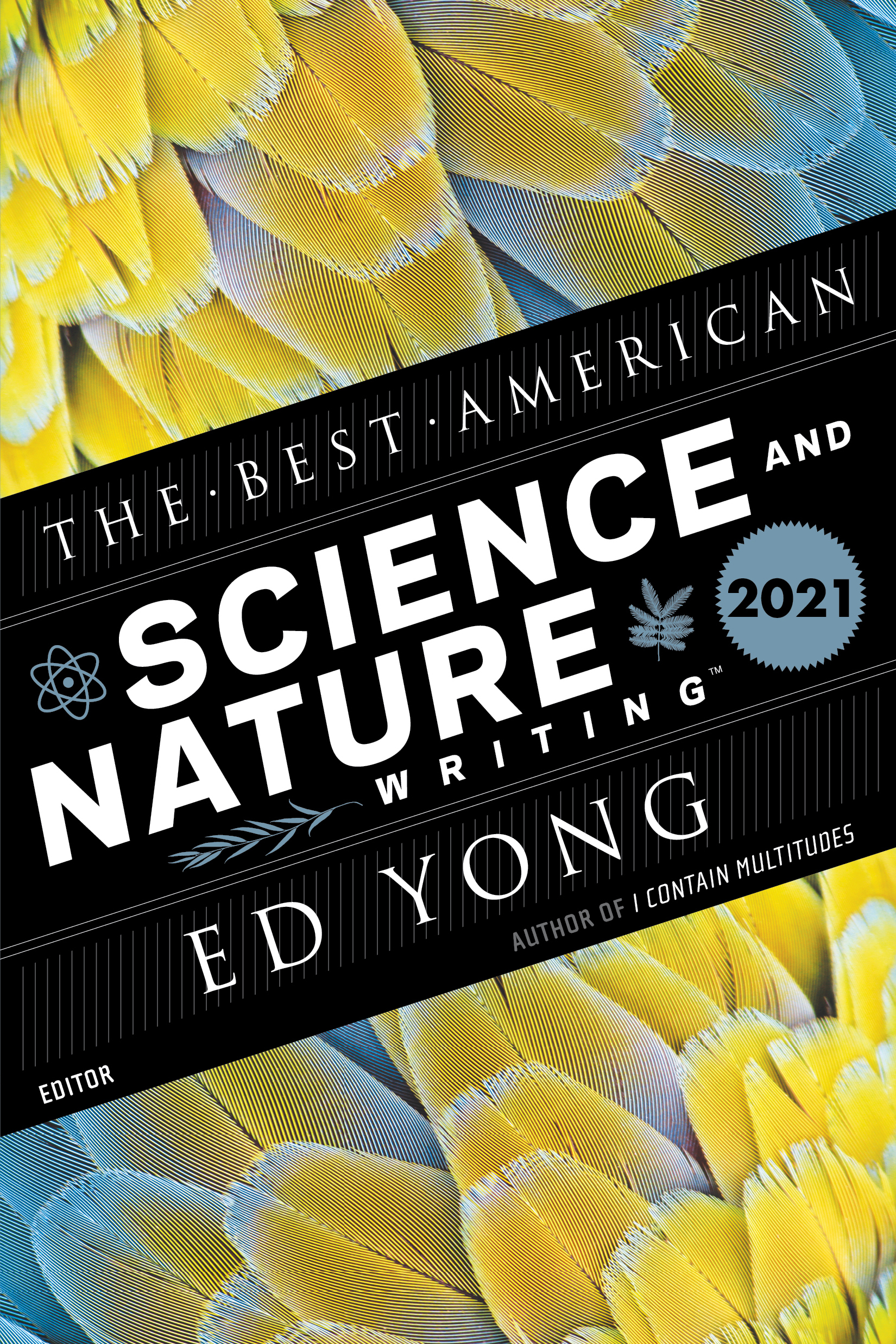
“Science is not a procession of facts and breakthroughs but an erratic stumble toward gradually diminished uncertainty; peer-reviewed publications are not gospel… and scientific endeavor is plagued by all-too-human failings like hubris.”
Ed Yong wrote that in the introduction to this book, and I have come back to read it more times than I can count. It is one of the most honest sentences about science I have ever encountered in print, and it set the tone for one of the heaviest, most thought-provoking reads I’ve had in a long time. Heavy in the best sense. And also, genuinely, in the physical sense. This book has been sitting on my bedside table for four months, and I could only manage one article at a time. Some books you race through. This one you sit with.
What This Book Is Actually About
Each year, a guest editor compiles The Best American Science and Nature Writing, a collection of what they consider the finest science articles published that year. In 2021, that editor was Ed Yong, a science journalist whose work I have admired for years and whose ability to find the human truth inside complex science is, in my opinion, unmatched.
The collection is organized into three themes, Contagion, Connections, and Consequences, and yes, COVID gets its own section, which given the year is entirely appropriate. But the book extends well beyond pandemic coverage, moving through ecology, medical ethics, systemic inequality in science, climate, and the quiet moral dilemmas that live at the edges of research most people never think about. Every piece was originally published in a magazine or journal, which means each one is tightly written, sharply edited, and built to make you think rather than simply inform. The combination of Yong’s editorial eye and the quality of the writing he selected makes this a genuinely exceptional document of what science communication looked like at one of the most consequential moments in modern history.
What Got Me Thinking
Read the introduction. Please. I know introductions are easy to skip, and I know this one is asking you to read an intro to a collection of essays you’ve already committed to, but it is one of the best things Yong has written, which is saying something. The quote at the top of this post comes from there, and it doesn’t even scratch the surface. He lays out a philosophy of science communication that I keep returning to: that the job isn’t to present science as a clean march toward truth, but to be honest about the stumbling, the uncertainty, the very human messiness of how knowledge actually gets made. That framing colored every article I read afterward.
The pieces themselves do something I don’t think any single book in this series has done quite as consistently: they make you feel your place in society as a scientist, and the weight of the moral and ethical dilemmas that come with it. These aren’t abstract questions. They’re questions about who gets to do science, who benefits from it, who gets left out, and what happens when the institutions that are supposed to protect scientific integrity fail to do so. Article after article, that reckoning is present, quietly, in different registers, from different angles.
The take-home message that crystallized for me over four months of reading one piece at a time: science is political. Not in the partisan sense, but in the deepest sense, it is shaped by funding, by power, by whose questions get asked and whose don’t, by the social structures scientists live and work inside. Science is not simply facts laid out before you. And science has limitations that are as important to understand as its capabilities.
I’d also say this: the pacing the format enforces, one article, then a break, then another, is actually the right way to read this book. Not because the writing is difficult, but because each piece gives you enough to think about that rushing to the next one would mean shortchanging the one you just finished.
Why I Think You Should Read This
Five out of five, with one honest piece of advice: read this alongside something lighter. Not because it’s depressing, but because the cumulative weight of serious, morally complex science journalism does something to you over time, and balancing it with something that makes you laugh or feel uncomplicated joy is genuinely good practice. I’d pair it with The Hitchhiker’s Guide and let the two talk to each other.
If you care about science communication, what it is, what it could be, what it owes the public, this book is essential reading. Yong assembled it at a moment when the stakes of science communication had never been more visible, and the pieces he chose reflect that seriousness without losing the wonder that makes science worth communicating in the first place.
My Takeaway
The sentence I keep returning to is the one about gradually diminished uncertainty. Not eliminated uncertainty, diminished. That’s the honest version of what science does, and it’s a harder thing to communicate than the triumphant narrative we often default to. But it’s also, I think, a more trustworthy one. When we tell the public that science moves in a straight line toward answers, we set them up to feel betrayed when the line turns out to be crooked. When we tell them the truth, that it stumbles, that it self-corrects, that it is human in all the ways that means, we build something more durable. That’s the kind of science communication this book is full of. And it’s the kind I want to keep working toward.
Come Read Along
Have you read any of the pieces in this collection, or do you have a favorite science article from 2021 that should have made the cut? Drop it in the comments or find me on Instagram. And if you have recommendations for what I should read next, I genuinely want to hear them.
April’s Science Read is Marketing for Scientists by Marc Kuchner, not the typical science book you might expect, but one I’d argue every scientist needs to read regardless of career stage. See you there. 📚