
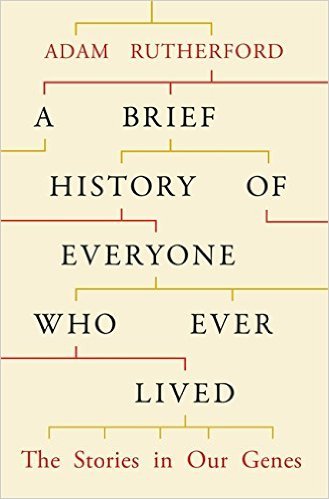
What if everything you think you know about your ancestry is both true and not nearly as simple as you’ve been told? That question is essentially the engine of this book, and it’s the kind of question that sounds almost casual until you’re three chapters in and your entire mental model of human genetics has been quietly, completely dismantled. I ended 2023 with this one, and I could not have chosen better. A Brief History of Everyone Who Ever Lived is exactly the book that reminds you why you fell in love with biology in the first place.
What This Book Is Actually About
Adam Rutherford is a geneticist, science writer, and broadcaster who has a rare and genuinely enviable gift: the ability to take four billion years of complex genetic evolution and make it feel not just accessible but thrilling, without ever sacrificing the actual science to do it. This book is his attempt to tell the story of humanity entirely through our genes, what they reveal about where we came from, how we’re all connected, and just as importantly, what they absolutely cannot tell us.
He takes us from the first bipedal apes four million years ago through the entire arc of scientists building on their predecessors to understand what our genome holds. Along the way he dismantles some of the most persistent myths about genetics, the science fiction thriller version of DNA where genes determine intelligence, predict behavior, or sort humans into clean categories. Our brains, he reminds us, are not more evolved than other species. They are differently evolved. The Human Genome Project didn’t solve our genome. It expanded our toolset to explore it further. Every answer, as always in science, opened more questions.
What Got Me Thinking
The line that stopped me in my tracks early on, “You carry an epic poem in your cells”, is the kind of science writing that makes you close the book for a moment just to sit with it. It’s not decoration. It’s the thesis. Everything Rutherford writes flows from that idea: that our genome is not a fixed blueprint but a living, layered, endlessly complex record of everything that had to happen for you to exist.
One of my longstanding fascinations has always been genetic ancestry, the Ancestry.com question. Can you really submit a saliva sample and find out what percentage English or West African or Scandinavian you are? Rutherford’s short answer is no. His long answer is one of the most illuminating things I’ve read about human inheritance. Six hundred years ago, the Black Death swept through Europe. Twenty percent of the people alive at that time left no living descendants whatsoever. The other eighty percent are, mathematically, ancestors of every person alive today. Every single one. Let that breathe for a second.
Human ancestry, Rutherford argues, is not a tree, it’s a tapestry. The strands stretch from one end of the world to the other, overlapping, doubling back, merging in ways that make clean ethnic percentages not just imprecise but conceptually misleading. That reframe hit hard, and it’s one I think about every time I see someone share their 23andMe results with absolute confidence.
The cell biology he weaves through the book, Virchow’s foundational principles, Schleiden and Schwann’s tenets, the understanding that disease is disrupted cellular physiology, grounds the whole narrative in something tangible. This isn’t just a story about ancient DNA. It’s a story about the living science that had to be built, piece by careful piece, before any of this was knowable at all.
Why I Think You Should Read This
Five out of five, the perfect note to end the year on and honestly one of the best science books I’ve read in years. Rutherford writes with the kind of enthusiasm that makes you trust him completely, and the clarity he brings to genuinely complex material is the standard I hold science communication up to. This is what it looks like when a scientist decides to tell the full story, not just the clean parts, not just the headline findings, but the whole sprawling, humbling, magnificent picture.
If you’ve ever submitted a DNA sample to an ancestry service, or wondered what your genome actually says about you versus what it can’t say, this book will give you a far more honest and fascinating answer than any algorithm.
My Takeaway
“The genome is a history book, and as long as there are people, our exploring will never be at an end.” That’s the sentence I closed the year on, and I think it’s the right one to carry into a new year of Science Reads. Science is not a march toward complete answers. It’s a continuously expanding map of better questions. Our genes don’t define us, they connect us, to each other and to every living thing that came before. The tapestry Rutherford describes isn’t just biological. It’s a reminder that individuality and interconnectedness are not opposites. They’ve always been the same story, told at different scales.
Come Read Along
Did you end 2023 with a book that rewired something for you? I’d love to hear what it was, drop it in the comments or find me on Instagram. And if you’ve been following Science Reads all year, thank you, genuinely. This community makes every single month of reading better.
January’s Science Read is Breaking Through by Katalin Karikó, Nobel Prize winner, mRNA pioneer, and one of the most remarkable stories in modern science. We’re kicking off the new year right. See you there. 📚