
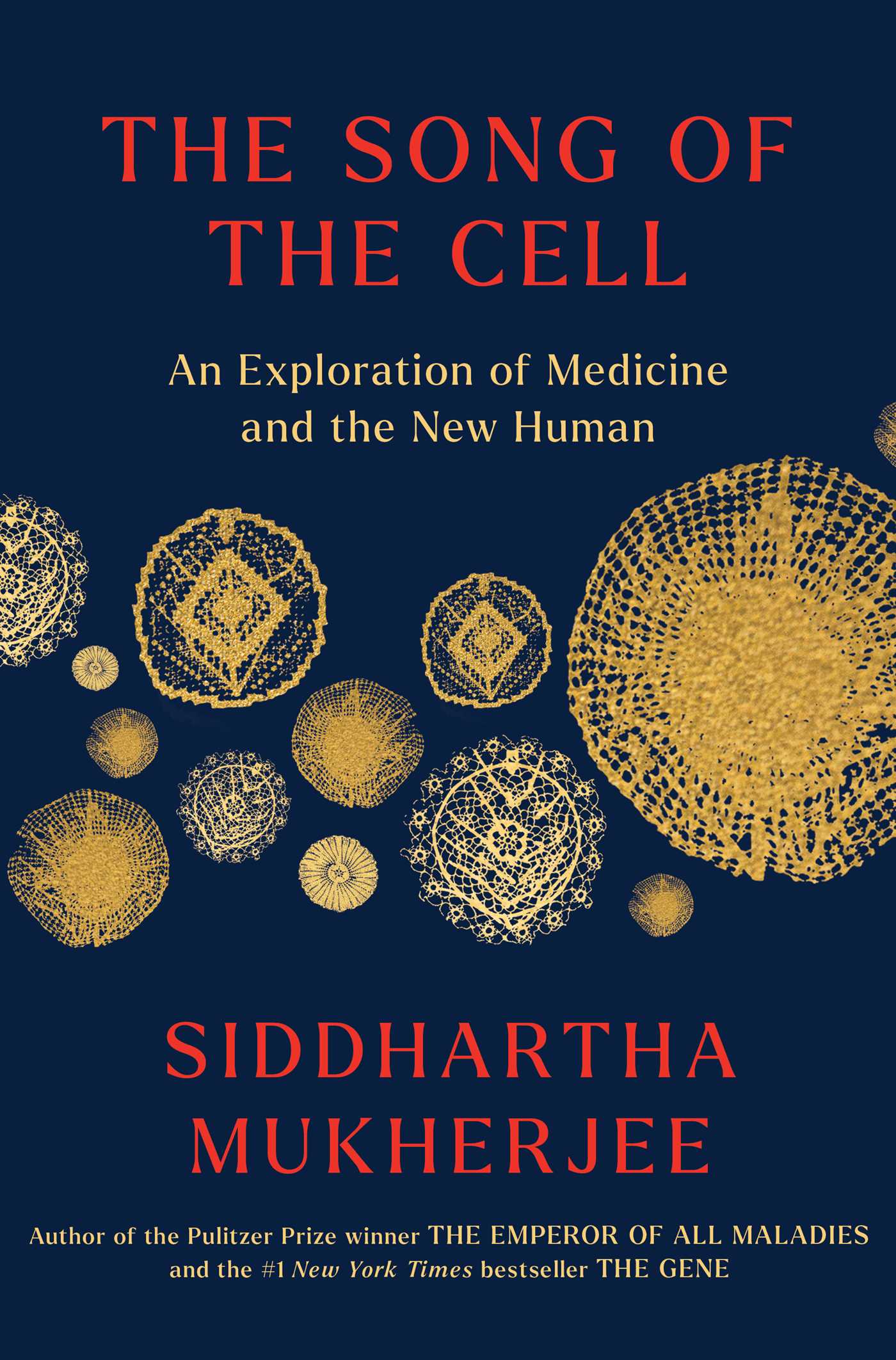
There are science writers who explain things clearly. And then there is Siddhartha Mukherjee, who does something else entirely, who takes the foundational machinery of life and turns it into something that reads like literature. I came into The Song of the Cell with a molecular biology background and a longstanding fascination with the ethical frontiers of cell biology, expecting to enjoy it. I did not expect to be moved by it. That’s the Mukherjee effect, and it got me again.
What This Book Is Actually About
Siddhartha Mukherjee is an oncologist, researcher, and author best known for The Emperor of All Maladies, his Pulitzer Prize-winning history of cancer that remains one of the finest pieces of science writing produced this century. In The Song of the Cell, released in 2022, he turns his attention to something even more fundamental: the cell itself.
The book is a sweeping, beautifully constructed journey through the entire history of cellular biology, from the first cells on Earth 3.5 to 4 billion years ago, through the gradual human discovery of our own anatomy and cellular function, through the stories of the scientists and patients whose lives were changed by those discoveries, all the way to the vast, barely mapped frontier of what cellular medicine might become. Mukherjee writes with the eye of a clinician and the instincts of a novelist, and that combination produces something rare: a science book that makes you feel the weight of what it means to understand life at its most basic level.
What Got Me Thinking
The opening quote sets everything up perfectly: “We can name cells, and even systems of cells, but we are yet to learn the songs of cell biology.” That word, songs, meaning interconnectedness, meaning the relationships between cells rather than their individual identities, runs through the entire book like a thread. And it reframed something I thought I already understood well.
The cell is the basic unit of life: autonomous, reproducible, capable of specializing to perform specific tasks within a body that depends on millions of them working in concert. Rudolf Virchow’s founding principle of cellular pathology, that all disease involves changes to normal cells, is the bedrock the book builds on. But Mukherjee’s argument pushes past that bedrock toward something more complex and more urgent. Understanding what individual cells do is no longer enough. The next frontier is understanding how cells work together, how the relationships between them, the communication, the signaling, the dynamic and constantly shifting ecosystem of a human body, produces either health or disease.
Cancer is the example he returns to most powerfully, and it stopped me cold every time. Cancer treatment isn’t difficult simply because there is one type of mutated cell. It’s difficult because there are many, constantly evolving, constantly mutating through Darwinian natural selection to survive the very drugs designed to destroy them. The tumor is not a fixed target. It is an adaptive system. And treating it requires thinking at the level of that system, not just the individual cell. Having read about game-theoretic modeling in cancer treatment earlier this year in Playing with Reality, this section hit with a particular resonance, the same idea arriving from a completely different direction.
The ethical dimensions of cellular medicine that Mukherjee weaves through the later chapters are where my eyes kept widening. Humans have been endeavoring to understand and harness cells to treat disease and rebuild parts of the body for decades. But the scale of what is now becoming possible, cell therapies, organoids, engineered tissues, raises questions that biology alone can’t answer. Mukherjee doesn’t shy away from those questions. He sits in the uncertainty with the same seriousness he brings to the science, and I deeply appreciated that.
Why I Think You Should Read This
Five out of five, one of the most satisfying reads of the year for anyone with a molecular biology or medical background. But I’d push back gently on limiting the recommendation to that audience. Mukherjee is genuinely accessible to any curious reader, and the story he tells, of how humans came to understand the basic unit of life, and what we are only now beginning to do with that understanding, is one that belongs to everyone.
If you loved A Brief History of Everyone Who Ever Lived for the way it reframed human genetics as something living and interconnected rather than fixed and deterministic, The Song of the Cell is a natural companion. Both books are ultimately about the same humbling truth: the closer you look at life, the more intricate and surprising the picture becomes.
My Takeaway
What I keep sitting with is the idea that we have spent centuries learning the names and functions of individual cells, and are only now beginning to hear the actual music. The relationships, the signals, the emergent behavior of cells in community with each other. That shift in scale feels like the shift that science communication needs to make too. We are very good at explaining individual facts, individual discoveries, individual breakthroughs. We are less practiced at conveying the interconnected system, the song underneath the notes. Mukherjee does it as well as anyone I’ve read. And it makes me want to try harder to do the same.
Come Read Along
If you’re in a biological or medical field, I especially want to hear how this one landed for you, what Mukherjee got right, what surprised you, what you wish he’d gone deeper on. Drop it in the comments or find me on Instagram.
December’s Science Read is a two-parter, starting with Elon Musk by Walter Isaacson. Yes, really. Come find out why I loved it. See you there. 📚