
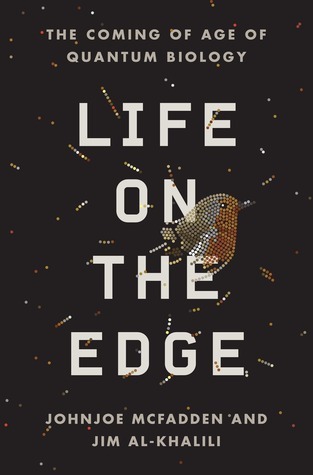
I have a confession that anyone who has followed my science journey for a while will find either amusing or entirely unsurprising: I picked biochemistry specifically because physics felt too abstract. Biology I could see, cells under a microscope, chemical reactions unfolding in real time, molecules with shapes and behaviors I could draw and hold in my mind. Physics felt like it existed in a dimension I couldn’t quite reach. Equations about things I couldn’t observe. Abstract in a way that never fully clicked for me. And then I read Life on the Edge, and spent a significant portion of it thinking about how differently my path might have looked if I’d found this book sooner.
What This Book Is Actually About
Life on the Edge is a collaboration between JohnJoe McFadden, a genetics professor, and Jim Al-Khalili, a theoretical physicist, and that pairing is the whole point. Together they make the case that quantum mechanics isn’t just a framework for understanding subatomic particles in a physics lab. It is actively, fundamentally at work in the biological processes we take for granted every single day.
The book moves through the history of both fields, tracing the discoveries in biology and physics that have quietly been answering each other’s questions for decades, and builds toward a single, genuinely stunning argument: that life didn’t just happen to exist within the physical world. Life evolved to exploit quantum effects, to harness the strange behavior of matter at the atomic level in ways that make biological systems more efficient, more precise, and more resilient than they could otherwise be. McFadden and Al-Khalili call this quantum biology, and by the time they’re done making their case, it’s hard to think about a cell the same way again.
What Got Me Thinking
I know DNA replication and transcription well, the mechanics, the error rates, the way mutations arise and propagate. I’ve spent years thinking about these processes at the molecular level. What this book cracked open for me was the layer underneath that, the quantum layer, the atomic level at which even these familiar processes are shaped by physics in ways I had never considered.
The example that genuinely stopped me: DNA replication creates molecular vibrations at the atomic level. The more frequently a region of the genome is read, the more vibrations accumulate, and the authors argue this quantum mechanical activity could explain why more frequently replicated regions of the genome are more prone to mutations. Quantum genes. I read that section twice. The idea that the mutation patterns I’ve studied in the context of cancer biology might have a quantum mechanical explanation, that physics reaches all the way down into the processes I work with every day, was the kind of perspective shift that makes you feel like you’ve been looking at a picture and suddenly noticed an entirely different image hidden inside it.
That’s the rhythm of the whole book. Every biological interaction I take for granted in my research has a physics explanation at the atomic level. Enzyme catalysis, photosynthesis, bird navigation, the sense of smell, McFadden and Al-Khalili walk through each one, showing how quantum effects don’t just lurk in the background but actively drive the biology. The history they weave through it, how discoveries in each field kept illuminating questions in the other, makes the whole thing feel like watching two long-running conversations finally realize they’ve been about the same thing all along.
Where the book lost me, and why it’s a 4 rather than a 5, is the section on consciousness. The authors use their quantum biology framework to reach toward an explanation of human consciousness, and somewhere in chapter eight, the clarity that carried the rest of the book started to dissolve. Neurons are explained as an argument for consciousness, but the conclusion I was supposed to reach never quite materialized. I closed that section genuinely uncertain whether I’d missed something or whether the authors had. Whatever the definition of consciousness and wherever it comes from, and these are real, open, fascinating questions, I would not go to this book for those answers.
Why I Think You Should Read This
A solid 4/5, and if you love biology or physics and want to understand the deep, elegant dance between the two that has been running through evolution all along, this book is absolutely for you. The consciousness chapters aside, McFadden and Al-Khalili are exceptional guides, rigorous enough to be trusted, accessible enough to be enjoyed by anyone who doesn’t have a physics background.
And if, like me, you spent years keeping biology and physics in separate mental compartments, this book will dismantle that partition in the most satisfying way possible.
My Takeaway
The thing I’m still sitting with is how much the tools we use to ask questions shape the questions we think to ask. I spent years in molecular biology without ever thinking seriously about what physics had to say about the processes I was studying. Not because the connection wasn’t there, it was always there, all the way down to the atomic level, but because my training gave me one set of lenses and I looked through those. Life on the Edge is an argument for building more lenses, for staying genuinely curious about what the fields adjacent to yours might see that yours can’t. That feels like important advice for any scientist, and maybe especially for science communicators trying to tell stories that are actually complete.
Come Read Along
Did this one spark any physics curiosity for the biologists in the room? Or did the physicists among you already know biology was this interesting? I want to hear from both sides, drop it in the comments or find me on Instagram.
June’s Science Read is Life and Research: A Survival Guide for Early-Career Biomedical Scientists, and if you’re in grad school, this one is for you specifically. See you there. 📚