
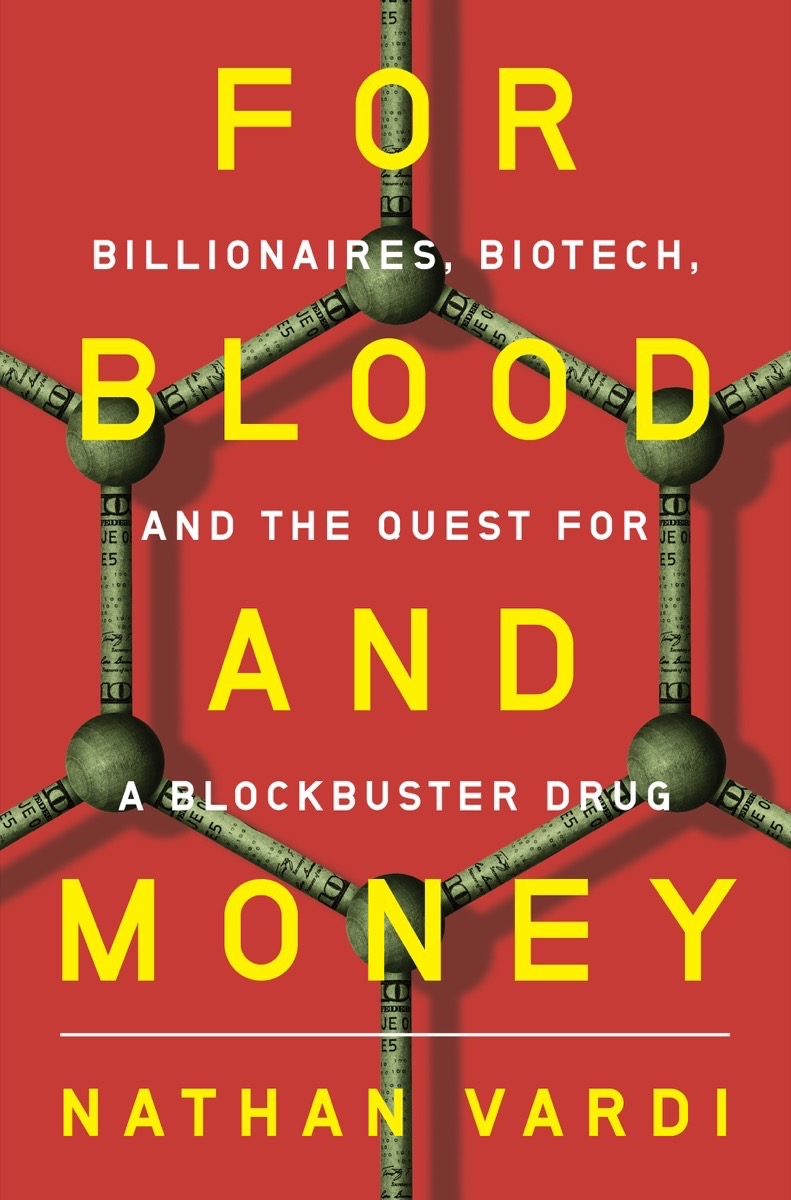
I do not say this lightly: I read this book in a weekend. I picked it up on a Friday and it was done by Sunday, not because I had nothing else to do but because I genuinely could not put it down. Science, money, ego, betrayal, billion-dollar payouts, and a blockbuster cancer drug at the center of all of it, For Blood and Money is the kind of book that reminds you that the most compelling stories in science aren’t always found in the lab. Sometimes they’re playing out in boardrooms and hedge funds and courtrooms, and the science is just the thing everyone is fighting over.
What This Book Is Actually About
For Blood and Money began as a Forbes story. Journalist Nathan Vardi became fascinated by Wayne Rothbaum, an extraordinarily elusive billionaire biotech investor whose fingerprints kept appearing on some of the most significant deals in the pharmaceutical industry. The more Vardi reported, the bigger the story got, until it had outgrown any magazine format entirely and demanded a full book.
What he ended up with is the account of one of the most dramatic drug development stories in recent biotech history: the race to bring two BTK inhibitors to market, cancer therapeutics designed specifically for blood cancers like leukemia, targeting the BTK pathway to regulate cell division like a light switch. The science is genuinely important. The human story wrapped around it is almost impossible to believe, except that it’s all real and all documented. The conflicts, the betrayals, the staggering sums of money, and the deeply unequal distribution of the rewards, it reads like something someone invented, and it isn’t.
What Got Me Thinking
The story splits into two tracks almost immediately, and the split itself is where things get interesting. Pharmacyclics was developing the first BTK inhibitor, financed heavily by investor Bob Duggan, a Scientologist with no formal scientific background who became one of the most controversial figures in the company’s history. Early in the process, Duggan fired two of the founding BTK scientists: Raquel Izumi and Ahmed Hamdy. They left, started their own BTK inhibitor company, Acerta, and kept going.
That second company was backed by Rothbaum, who had originally been one of Pharmacyclics’ biggest investors before backing out at exactly the wrong moment. Fueled by what sounds very much like a refusal to let that mistake stand, he poured his resources into the startup the fired scientists had built. Two companies. Two drugs. Both targeting the same pathway. Both racing toward the same market. Both eventually acquired by major pharmaceutical companies, Pharmacyclics for $35 billion, Acerta for $7 billion.
And then comes the part of the story that I haven’t been able to shake. Duggan and Rothbaum made 70x and 35x their original investments respectively. Duggan’s payout is considered one of the largest Wall Street returns of any industry, ever. The scientists who designed the clinical trials, the people who did the actual scientific work of figuring out whether these drugs worked and who they worked for, became multimillionaires. But due to the complex structuring of their stock options, they captured only a fraction of the wealth their work created. The annual prescription cost for either drug sits at roughly $160,000.
That gap, between who creates the science and who profits from it, is a thread that runs through the entire book and connects directly to conversations happening right now about drug pricing, biotech investment, and who the pharmaceutical industry ultimately serves. Vardi doesn’t editorialize heavily. He lets the numbers speak, and they speak loudly.
Why I Think You Should Read This
Five out of five, one of my favorite Science Reads to date, and I’d recommend it to almost anyone. If you work in biotech, pharmaceutical development, or research, this is a masterclass in how drugs actually make it from a scientific hypothesis to a prescription, and how much of that journey has nothing to do with science. If you’re interested in the business and investment side of medicine, it’s one of the most compelling case studies of the biotech market climate I’ve encountered.
And if you just love a story where the stakes are genuinely enormous and the characters are stranger than fiction, don’t walk, run.
My Takeaway
What I keep sitting with is the question of credit, and how differently it gets distributed between the people who imagine a scientific possibility, the people who prove it works, and the people who finance the proof. The scientists who built these drugs changed the lives of blood cancer patients in measurable, documented ways. The investors who bet on them walked away with returns that rewrote their net worth. Both things are true simultaneously, and the system that produced that outcome wasn’t accidental. It was designed. Understanding how it was designed, who benefits, who doesn’t, and why, feels like essential knowledge for any scientist thinking about where their work goes after it leaves the lab. For Blood and Money is one of the clearest windows into that world I’ve found.
Come Read Along
Have you read this one? Or do you have a biotech story that’s equally unbelievable and entirely true? I want to hear it, drop it in the comments or find me on Instagram.
May’s Science Read is Life on the Edge by JohnJoe McFadden and Jim Al-Khalili, quantum biology, and the book that almost made me reconsider my complicated relationship with physics. See you there. 📚