
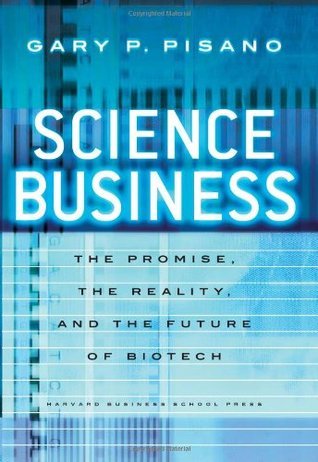
When I started graduate school, I made a decision that felt slightly terrifying at the time: I was going to learn the business side of biotechnology, not just the science. And for a while, that process felt exactly like what it was, stumbling in the dark, googling terms I’d half-heard in informational interviews, trying to build a mental map of an industry from scattered pieces that didn’t always connect. I wish, with a sincerity I cannot overstate, that someone had handed me this book at the start of that process. It would have saved me a lot of very confused evenings.
What This Book Is Actually About
Science Business is Harvard Business School professor Gary Pisano’s attempt to answer a question that sounds simple and turns out to be anything but: why hasn’t biotechnology, despite decades of revolutionary science, consistently produced profitable businesses? The book covers the development of the biotech industry from the 1970s through the early 2000s, examines what makes biotech fundamentally different from other established industries, and makes a clear-eyed argument for how the industry needs to change if it’s going to fulfill the extraordinary promise of its science.
A note worth making upfront: this book was published in the early 2000s, so some of the specific predictions and prescriptions have aged differently than others. But as a foundational overview of how biotechnology developed as both a scientific and commercial enterprise, what it got right, what it got structurally wrong, and why, it remains one of the clearest, most useful frameworks I’ve found. I only wish I’d started here before diving into the deeper histories of individual companies like Genentech and Amgen. This is the context that makes those stories make sense.
What Got Me Thinking
Pisano structures the history of biotech around three waves, and that framework alone is worth the read. The first wave was built on large molecules, the founding of companies like Genentech, the creation of the biotech model of spinning university research into companies, and the early products: replacement hormones, recombinant proteins, monoclonal antibodies. The second wave came as the reality of drug development risk set in with investors, pushing companies toward earlier collaboration with pharmaceutical partners and opening the door to gene therapy, cell therapy, and tissue engineering. The third wave arrived with the Human Genome Project, ushering in high-speed automation, large-scale data analysis, and the genomics platforms that still define much of the industry today.
Seeing those three waves laid out clearly, understanding the logic of each transition, why the industry moved the way it did and when, reorganized a lot of things I had learned piecemeal into something coherent. That reframe is the book’s most immediate gift.
But the structural problems Pisano identifies are where things get genuinely thought-provoking. The gap between academic research and translational science, the valley of death where promising discoveries run out of funding before they become startups, is still one of the most pressing challenges in the field. The estimated 1 in 6,000 compounds that ever makes it to market puts the risk profile of this industry in stark, almost vertiginous terms. The ten to twelve year development timeline for a product creates an almost impossible tension with the short-term earnings pressure that comes with being a public company. The $800 million overhead required to develop a product is a number that reshapes how you think about every drug pricing conversation you’ve ever had. And the deep specialization of science, the way expertise silos itself, working directly against the interdisciplinary research that produces the best breakthroughs is a problem that universities and funding bodies are still, two decades later, actively wrestling with.
None of these are new problems. That’s part of what makes Pisano’s framework so useful, it shows you that the structural tensions in biotech aren’t bugs that crept in recently. They were baked in from the beginning, and understanding their origins makes the current landscape significantly easier to read.
Why I Think You Should Read This
Five out of five, and if you’re in grad school trying to understand how the science you’re doing connects to the industry you might eventually work in, start here. Read this before you read the company-specific histories, before the investor narratives, before the drug development deep dives. This is the map that makes all of those other stories navigable.
Yes, it’s from the early 2000s. The specific numbers have shifted and some of the predictions have dated. But the structural logic, the fundamental reasons why turning science into a sustainable business is so much harder than it looks, is as relevant now as it was when Pisano wrote it.
My Takeaway
The thing I keep returning to is the gap between scientific value and commercial viability, and how much of the biotech industry’s history is essentially an extended, expensive negotiation between those two things. The science that matters most is often the science that’s hardest to fund, slowest to develop, and most resistant to the timelines that investors and public markets demand. Understanding that tension doesn’t make it easier to solve. But it does make it easier to navigate, and it makes you a sharper, more clear-eyed participant in the conversations about where research goes after it leaves the lab. That clarity, more than anything, is what this book gave me.
Come Read Along
Are you in the early stages of trying to understand the biotech industry, or do you have a resource that helped you make sense of it faster than I did? Drop it in the comments or find me on Instagram. Genuinely, I want to know.
April’s Science Read is For Blood and Money by Nathan Vardi, and I read it in a single weekend. That tells you everything. See you there. 📚