
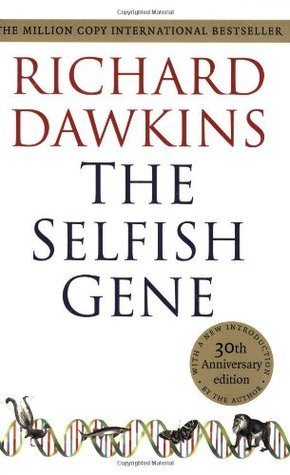
There is a specific kind of reading experience that only happens when you return to a book you first encountered before you were ready for it. I read The Selfish Gene for the first time as an assigned reading in high school chemistry class. I retained almost nothing, which, in my defense, is mostly because I was in high school and the idea of reading anything for fun felt like a personal affront. But coming back to it now, as a working scientist with years of biology and biochemistry behind me, felt like meeting an old acquaintance and finally understanding what they were actually saying. I’m so glad I came back.
What This Book Is Actually About
The Selfish Gene, published in 1976, is Richard Dawkins’ landmark argument for understanding evolution from the perspective of the gene rather than the individual organism or the species. The premise sounds almost provocative in its simplicity: our genes are selfish. Every single one of them. And Dawkins argues that the entire arc of our existence, our bodies, our behaviors, our social instincts, even our capacity for altruism, can be understood as the product of genes relentlessly pursuing one goal: their own survival and replication.
He calls our bodies “survival machines”, vehicles that evolution has shaped over millions of years not for our benefit, but for theirs. That reframe is disorienting the first time you encounter it, and then, as the book builds its case chapter by chapter, it becomes almost impossible to unsee. It is one of the most foundational arguments in modern biology, and nearly fifty years after it was first published, it still holds up as a framework for understanding how we got here.
What Got Me Thinking
I want to be honest: this book is long-winded. The analogies are extended and the arguments circle back on themselves repeatedly, which is, I suspect, a significant part of why high school me checked out entirely. But coming back to it with context, I can see exactly what Dawkins is doing with that length. The overlapping, layered arguments aren’t padding. They’re the method. Each chapter builds on the last in ways that are hard to extract individually, which is also why I’m not going to try to summarize the main points here, every chapter has them, and pulling them apart does the book a disservice.
What I can share are the ideas that have stuck with me most viscerally. Everything in your body is competing, not just against the outside world, but internally, at the level of the genome itself. The “mistakes” in our genome, the mutations and errors that might seem like flaws, are actually what make evolution possible. Evolution happens in spite of genes, not because of them. Natural selection favors conformity until it doesn’t. And then there’s the one that stopped me completely: altruism, genuine selflessness, is often more successful in the long run precisely because it serves gene survival better than straightforwardly selfish behavior does. The most cooperative instincts we have are, at their deepest level, genetic strategy. That is either deeply comforting or deeply unsettling depending on the day, and I’ve been both about it.
The idea of competing strategies creating stable behavioral patterns, what Dawkins develops through game theory before game theory was widely applied to biology, is something that echoes forward into so many of the other books in this reading series. The selfish gene framework keeps showing up in unexpected places once you have it, and that’s the mark of a genuinely foundational idea.
Why I Think You Should Read This
Five out of five, one of the most foundational books for understanding biology and evolution, full stop. If you are in any biological field and haven’t read this, it belongs on your list. If you read it years ago and didn’t quite absorb it, come back. The book rewards the re-read in a way that very few science classics do, especially once you have enough biology behind you to feel the arguments land in real time rather than taking them on faith.
Yes, it’s long. Yes, Dawkins takes his time making each point. Give it that time. It earns it.
My Takeaway
What strikes me most, returning to this book as a scientist rather than a reluctant high schooler, is how much it changed the level at which I think about biology. Before The Selfish Gene, my instinct was to understand life at the level of the organism, the cell, the body, the individual. Dawkins shifted that lens down one level, to the gene, and suddenly a whole range of biological phenomena that had always felt slightly mysterious, cooperation, competition, altruism, the strange logic of natural selection, snapped into focus. The best foundational science books don’t just give you information. They give you a new place to stand when you look at everything else. This is one of those books, and I am genuinely glad I gave it a second chance.
Come Read Along
Have you read The Selfish Gene, and if so, what were your favorite parts? I’d especially love to hear from anyone who read it young and came back to it later. Drop it in the comments or find me on Instagram. This is the book that started Science Reads for me, and it feels right to begin there together.
February’s Science Read is I Contain Multitudes by Ed Yong, a completely different scale of biology, but the same spirit of making you see the living world entirely differently. See you there. 📚