
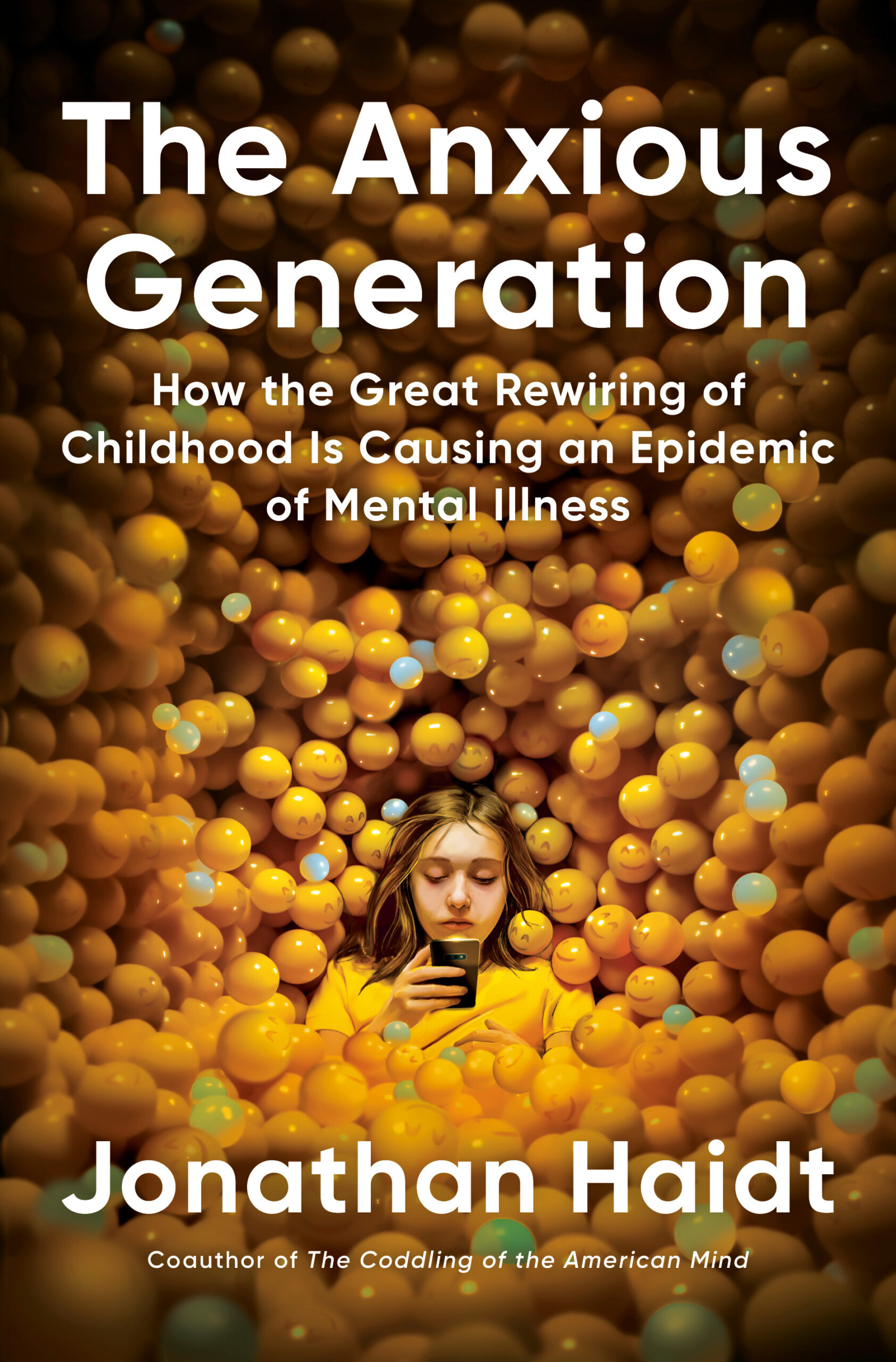
I don’t think I’ve recommended a book this urgently to people in my life in a long time. The Anxious Generation is one of those reads that starts as an intellectual exercise and ends as something far more personal, because whether you’re a parent, a researcher, an educator, or just someone who has spent a significant portion of their life on social media, this book is about you. It’s about the world we built, and what it has quietly cost an entire generation.
What This Book Is Actually About
Jonathan Haidt is a social psychologist at NYU, and The Anxious Generation is his carefully constructed argument for why Gen Z became the most anxious, depressed, and mentally fragile generation on record. His central thesis is deceptively simple: we have simultaneously overprotected children in the real world and underprotected them in the virtual one. The result is a generation that grew up with fewer opportunities for independent play, genuine risk, and face-to-face social development, and far too much unsupervised exposure to social media during the years their brains were most malleable.
Haidt structures the book in four parts: the mental health trends in adolescents, where childhood went wrong, the specific harms of a phone-based childhood, and, importantly, how we can actually reverse the damage. Throughout, he uses graphs and data to trace the correlation between rising smartphone use and the dramatic spike in adolescent anxiety and depression, methodically addressing alternative explanations along the way, including the 2008 financial crisis and broader societal instability.
What Got Me Thinking
The four reforms Haidt proposes are worth sitting with, no smartphones before high school, no social media before 16, phone-free schools, and far more unsupervised play and childhood independence. On the surface, they sound simple. In practice, they require a collective shift in how we think about childhood, technology, and responsibility that goes well beyond any individual parent’s choices.
And I want to be honest about the debate here, because I think it matters. Psychologist Candice Odgers wrote a critical review of this book in Nature, raising two significant objections: that Haidt’s evidence is correlational rather than causal, and that other researchers have not been able to consistently replicate the link between social media use and adolescent mental health deterioration. She doesn’t dismiss the need for reform, she concedes our generation needs to seriously rethink how we use social media, but she pushes back on what she calls the “simple” narrative Haidt builds around it.
I think both things can be true. The data Haidt presents is striking and worth taking seriously. And the critique that correlation isn’t causation is a real scientific caution, not a dismissal. What I keep coming back to is that even if the causal chain is more complicated than a straight line from Instagram to anxiety, the underlying conditions Haidt describes, a childhood increasingly lived through screens, a loss of unstructured independence, a social environment built around performance and metrics, are real. I’ve seen it. I’ve felt versions of it in myself. And I’ve also experienced the genuine good that social media can hold. The answer isn’t to pretend the benefits don’t exist. It’s to be honest that the current model isn’t working, and that adolescents are where the stakes are highest.
This also isn’t just on parents. That framing lets too many people off the hook. Governments and tech companies have to be held accountable. It is not new information that social media is “free” because we are the product, that the entire architecture is built around capturing attention, optimizing engagement, and converting our behavior into marketing data. And the rest of us, the people actually using these platforms, posting, scrolling, performing, have a role too. What image are we projecting? What norms are we reinforcing for the people watching?
Why I Think You Should Read This
A full 5/5, and I mean it when I say I think everyone should read this book, not just parents or educators. If you use social media, if you work in tech, if you care about public health, mental health, or the shape of the next generation, this is required reading. Haidt writes with urgency but not alarmism, and even where his argument invites pushback, that pushback is worth having. Read it alongside Odgers’ Nature review for a complete picture. Read it alongside Playing with Reality by Kelly Clancy for a deeper lens on how games and digital environments are reshaping human minds. These books are in conversation with each other in ways that feel increasingly important.
My Takeaway
What I can’t stop thinking about is the phrase “underprotection in the virtual world.” We spent so much energy warning children about strangers and traffic and the dangers of the physical world, and then handed them a device with unrestricted access to an environment specifically engineered to be as psychologically compelling as possible. No guardrails. No supervision. No developmental scaffolding. And we’re surprised by what happened. Science communication has a role to play here too, in translating this research clearly, in holding the complexity without losing the urgency, and in making sure the public conversation about social media and mental health is driven by evidence rather than panic or denial. We’re all part of this system. The question is whether we’re willing to be part of changing it.
Come Read Along
This one sparked more conversations in my personal life than almost any book I’ve read this year, I’d love to know how it lands for you. Are you persuaded by Haidt’s argument? Skeptical? Somewhere in the middle? Drop your thoughts in the comments or find me on Instagram where this kind of conversation is always welcome.
June’s Science Read is An Immense World by Ed Yong, a completely different world from adolescent mental health, but equally hard to put down. See you there. 📚