
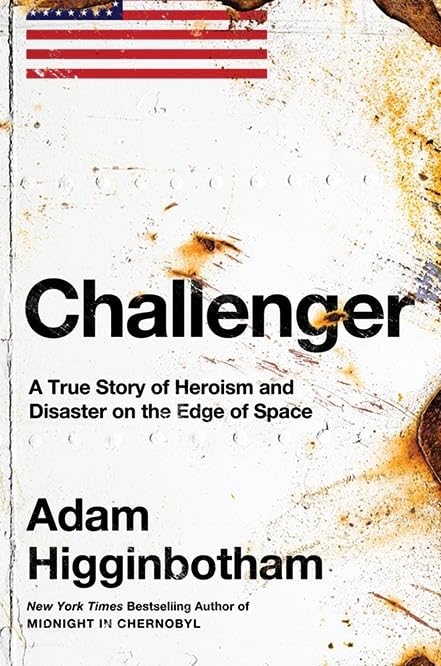
Let me be upfront about something before we get into this one: it took me three months to finish. Not because the book isn’t good, it is, genuinely and impressively good, but because I am, at my core, a cells-and-bugs person. Diseases we can see under a microscope. Consequences we can trace through a body. Space science has always felt abstract to me in a way I’ve never quite been able to bridge, and Challenger lives firmly in that territory. I want to be transparent about that bias, because I think it’s the only honest way to review a book I deeply respect and cannot call a page-turner.
What This Book Is Actually About
Challenger is Adam Higginbotham’s meticulously reconstructed history of one of the most consequential disasters in the history of American science, the 1986 Space Shuttle Challenger explosion, which killed all seven crew members 73 seconds after launch and sent NASA and the American space program into decades of stagnation. Higginbotham, who also wrote the acclaimed Midnight in Chernobyl, brings the same obsessive archival rigor to this subject, interviewing survivors, families, engineers, and officials, and reconstructing events from the ground up with a level of detail that is both extraordinary and, at times, genuinely dense.
What distinguishes the book from a straightforward disaster narrative is its scope. Challenger is not just about why one mission failed. It is about the entire arc of the American Space Age, the extraordinary momentum of the 1960s and 70s, the Cold War pressure to outpace the Soviet Union, and all the small, compounding factors that quietly eroded the culture of safety and rigor that the early program was built on. The Challenger disaster, Higginbotham argues, didn’t happen suddenly. It was assembled, incrementally, over years.
What Got Me Thinking
The argument that hit hardest, and that I think extends well beyond NASA, is the portrait of how institutional culture degrades under sustained pressure. Public interest in the space program waned after the initial rocket launches, and with it went the scrutiny that had kept safety standards sharp. The quadruple-checking that characterized the early program became an obstacle to timeline. Engineers were given goals that felt, and in some cases genuinely were, impossible. And somewhere in that gradual erosion, sticking to a launch schedule became more important than the safety concerns individual engineers were raising and being asked to set aside.
That arc, from extraordinary rigor to normalized risk, is one of the most important patterns in the history of institutional failure, and Higginbotham traces it with clarity and without simplifying the human complexity underneath it. No single villain. No single moment where everything went wrong. Just a series of small decisions, each of which seemed defensible in isolation, accumulating into a catastrophe.
The chapter structure mirrors that accumulation in a way that is impressive even when it’s slow, each section adding one more layer to a picture that only becomes fully visible at the end. I can see exactly why this book has been described as a thriller. For readers who find space history naturally gripping, it probably is one. For me, the density was real, and I want to be honest about that rather than pretend the three months it took me to finish were effortless.
Why I Think You Should Read This
Four out of five, and I’m knocking off one star specifically because the thriller framing that accompanied the marketing didn’t quite match my experience of reading it, and I think that mismatch is worth naming for anyone else who, like me, finds space science more abstract than visceral. That is a reader preference note, not a quality note. The quality is unimpeachable.
If you are fascinated by the history of the space program, by institutional failure, by the human cost of bureaucratic pressure on scientific decision-making, this is among the best books you will find on those subjects. Higginbotham is a remarkable reconstructive historian, and the level of care that went into this book is evident on every page. I cannot think of a better way this history could have been written.
My Takeaway
What I keep sitting with is how much the Challenger disaster has to say about the relationship between external pressure and scientific integrity, a relationship that feels urgently relevant right now. When timelines matter more than safety checks, when engineers raising concerns are asked to stand down, when the culture of an institution shifts from “is this ready?” to “we need this to be ready”, the consequences are sometimes catastrophic and always foreseeable in hindsight. Science communication has a role here too: keeping the public engaged with the work, so that the scrutiny that comes with public interest never fully fades. The space program stagnated in part because people stopped watching. What we stop watching, we stop protecting.
Come Read Along
Have you read Challenger, and did it grip you the way it’s been described? I’m genuinely curious whether the thriller framing landed differently for readers who love space history. Drop it in the comments or find me on Instagram. And if you want to find all of these books with my full reviews, my Goodreads account is linked in my bio 📚
March’s Science Read is The Kissing Bug by Daisy Hernandez, and I have already started it, and I am already telling you to go get a copy so you can read along. See you there. 🫶