
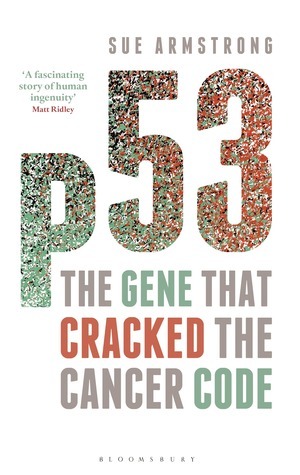
I went into this one with high expectations, and came out with genuinely mixed feelings. Which, honestly, might be the most scientist thing I can say about a book. I didn’t love it unconditionally, I didn’t dismiss it, and I’m still thinking about parts of it weeks later. If you’ve ever wanted to understand the full history of p53, the most studied protein in the world, this book will take you there. Whether the journey feels like a page-turner or a slow graze depends a lot on what you’re looking for.
What This Book Is Actually About
p53: The Gene that Cracked the Cancer Code by Sue Armstrong is exactly what it sounds like, a deep dive into the discovery, study, and evolving understanding of p53, the tumor suppressor gene that has become central to cancer research over the past several decades. Armstrong is a science journalist who has been reporting on p53 for years, and that accumulated knowledge shows. The book functions as a one-stop shop for the history of this protein, covering the major breakthroughs, the setbacks, the key players, and the scientific debates in a way that a review paper simply couldn’t capture with the same accessibility.
For anyone coming to this without a molecular biology background, that accessibility is real and valuable. For those of us coming from the bench, it reads less like a revelation and more like a well-organized deep dive into a story we’ve touched in pieces but never seen assembled in full.
What Got Me Thinking
Despite my mixed feelings on the structure, there were moments in this book that genuinely stopped me mid-chapter.
The emphasis on collaboration was one of them. Some of the biggest breakthroughs in p53 research didn’t come from a single brilliant mind working in isolation, they came from disciplines colliding in unexpected ways, like the intersection of cancer biology and apoptosis research. That’s a reminder worth repeating in science communication: the most important discoveries often happen at the edges where fields meet, not at the center of any one of them.
The role of chance and repetition also hit differently than I expected. The story of how p53 mutants were caught, through sheer persistence, repeated experiments, and a fair amount of luck, is a much more honest portrait of how science actually works than most textbooks ever offer. That’s exactly the kind of narrative science communication needs more of.
And then there’s the slower, more uncomfortable truth: even when the evidence is there, changing a scientific theory takes time. The field resisted certain findings about p53 longer than the data warranted. That tension between evidence and consensus is something every scientist recognizes, and Armstrong captures it well.
Where the book loses me is in its structure. Because Armstrong is first and foremost a journalist, the book reads like a series of well-researched news articles rather than a single cohesive narrative. So many names, so many institutions, so many places, it becomes genuinely difficult to hold the thread. And the ending, which quotes scientist Gerard Evan saying he’s confident his kids will “never, ever have to worry about dying from cancer,” felt a step too far into optimism for a book that otherwise does a good job of honoring scientific complexity.
Why I Think You Should Read This
This is a 4/5 from me, and I mean that thoughtfully, not as a consolation rating. The amount of work it would take to compile this much history on the most studied protein in the world into a single, accessible book is genuinely impressive, and Armstrong deserves enormous credit for it.
Just go in with the right expectations. This isn’t a “couldn’t put it down” kind of read. It’s more of a “graze a chapter a day” book, one you return to, sit with, and let accumulate over time. If you want a comprehensive explanation of p53’s discovery and the scientific debates that shaped our understanding of it, this delivers. If you’re hoping for a single driving narrative that carries you through, you might find yourself a little adrift.
My Takeaway
What I keep returning to is how much of science is actually built on chance, repetition, and the slow, grinding work of changing minds, even in the face of good evidence. We tend to tell science as a story of eureka moments and linear progress. The real story of p53 is messier, more collaborative, and more human than that. And as someone who thinks a lot about how we communicate science to the public, that messiness matters. The more honestly we tell these stories, uncertainty, luck, resistance, and all, the more trust we build with the people we’re trying to reach.
Come Read Along
Have you read this one? I’d love to know how it landed for you, especially if you’re coming from a research background. Drop your thoughts in the comments or find me on Instagram where the conversation never really stops.
November’s Science Read is Persuading Scientists by Hamid Ghanadan, and it’s a very different kind of book. See you there. 📚