
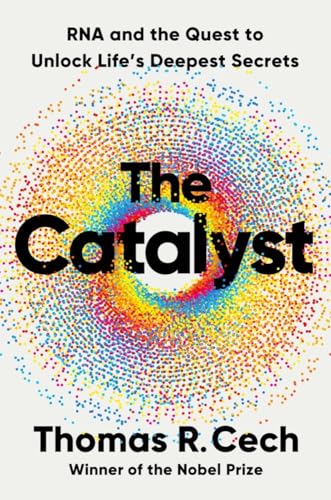
I have two things to say before we get into this. First: why is there no RNA emoji? There is a DNA emoji. There is a microbe emoji. The molecule that is quietly running more of the show than most people realize deserves its own emoji, and I will be thinking about this injustice for longer than is probably reasonable. Second: this is the first Science Read in this entire series that made me genuinely miss the lab bench. I did not expect to be writing those words from my honeymoon. And yet here we are.
What This Book Is Actually About
The Catalyst is written by Thomas R. Cech, Nobel Prize winner in Chemistry in 1989, awarded for discovering that RNA isn’t just a passive messenger between DNA and proteins but can itself act as a catalyst, actively driving chemical reactions in the cell. That discovery rewrote a fundamental assumption of molecular biology, and Cech’s book is his attempt to bring general readers inside the full sweep of what RNA research has revealed in the decades since, and why it matters far more than most people realize.
The book moves through RNA’s history chapter by chapter, each one packed with discoveries and the scientists behind them, building from the basics of what RNA is and does, through the landmark findings that expanded our understanding of its roles, all the way to the mRNA vaccine technology that became a household conversation in 2020. Cech writes with the clarity of someone who has spent decades making complex science accessible, and with the humility of someone who understands that no discovery happens in isolation. Collaboration, funding battles, gender discrimination, the limitations of available techniques, the constraints of model organisms, he engages with all of it honestly, and that honesty is a significant part of what makes this book feel trustworthy rather than triumphalist.
What Got Me Thinking
I should be transparent: my PhD research was in non-coding RNA, which means reading this book felt like a light, deeply satisfying refresher on territory I know intimately, and also like being reminded, repeatedly, why I fell in love with it in the first place. Non-coding RNA was for a long time the part of the genome dismissed as “junk”, sequences that didn’t code for proteins and therefore, the assumption went, didn’t do much of anything. The story of how that assumption was dismantled, discovery by discovery, is one of the most exciting narratives in modern molecular biology, and Cech tells it with the enthusiasm it deserves.
What I appreciated most was how each chapter builds on the last, a discovery opens a question, the question drives the next experiment, the next experiment reveals something no one expected, and suddenly the picture of what RNA can do has expanded again. It never feels drawn out. It feels like momentum.
The argument Cech makes about basic science funding is the one I haven’t been able to stop thinking about, especially given how much the funding landscape has shifted since this book was published in 2024. Most people now associate RNA with vaccines, and rightly so. But those vaccines only existed because researchers spent decades studying RNA with no particular medical application in mind, asking fundamental questions about what RNA is and what it can do, long before anyone thought to ask whether it could be used therapeutically. Disease-targeted research is valuable and necessary. But without the basic science that preceded it, the translational research has nothing to build on. Cech makes that case clearly and urgently, and the timing of this book, arriving just as basic science funding faces increasing pressure, gives that argument a weight that feels uncomfortably prescient.
The one honest note: the book covers so much ground and involves so many scientists and discoveries that it doesn’t read like a novel with a single protagonist driving the story forward. If you’re coming in hoping for the narrative momentum of something like The Emperor of All Maladies, you may find this more dense. But if you’re willing to follow the science as the protagonist, letting each discovery lead you to the next, the structure works beautifully.
Why I Think You Should Read This
Six out of five, and I’m standing by it. This is one of my new favorite science reads in the entire series, and not just because the subject matter is close to my own research. Cech does something genuinely difficult, he takes decades of worldwide scientific collaboration, involving hundreds of researchers across multiple fields, and weaves it into a narrative that never loses the thread or the wonder. The science is rigorous. The storytelling is warm. And the argument about why we need to protect basic research funding is one that everyone, scientists and non-scientists alike, needs to be hearing right now.
My Takeaway
What I keep carrying from this book is the reminder that the most transformative discoveries in science are almost never the ones anyone planned for. RNA catalysis, non-coding RNA, mRNA vaccines, none of these were the intended destination when the researchers who laid the groundwork started their experiments. They were following questions, not applications. And the funding structures that allow that kind of open-ended, curiosity-driven inquiry, the basic science that looks impractical until suddenly it isn’t, are exactly what’s under pressure right now. Protecting that space isn’t just good science policy. It’s how we ensure the next unexpected breakthrough actually gets to happen.
Come Read Along
RNA enthusiasts, molecular biologists, and anyone who has ever wondered what their cells are actually doing, this one is for you. Drop your thoughts in the comments or find me on Instagram. And yes, there’s a honeymoon sneak peek in the photo, any guesses where we went? 🌍
August’s Science Read is Everything is Tuberculosis by John Green, a completely different corner of the science world, but just as important a conversation. See you there. 📚