
I will start by telling you that the photo accompanying this post was taken by my husband, who I asked to take it, and who produced exactly the kind of photo you’d expect from someone who was asked to take your photo. Some things are universal. So is tuberculosis, apparently, which is the kind of sentence I did not expect to be writing this month, and yet here we are.
What This Book Is Actually About
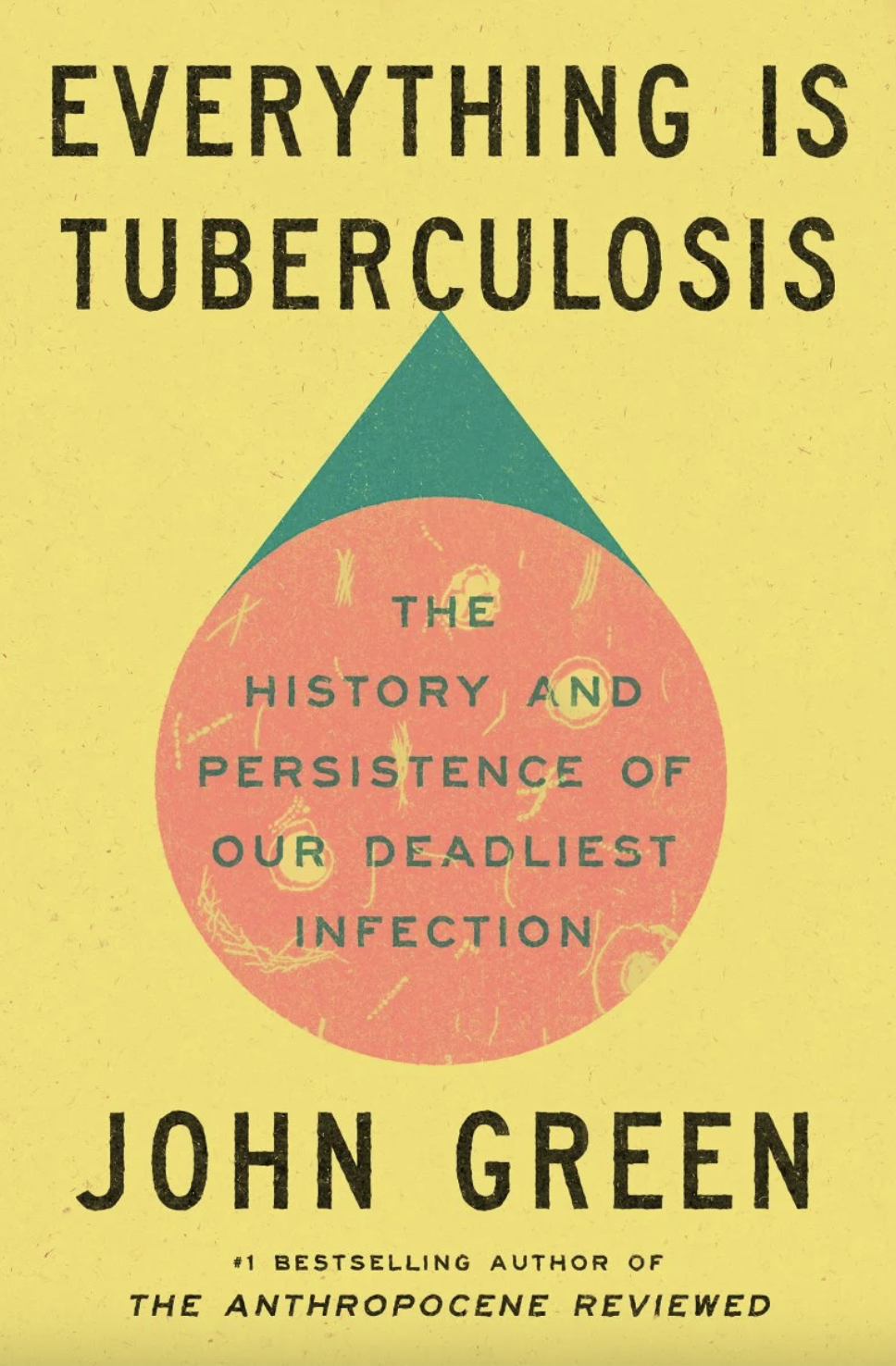
Everything is Tuberculosis is author John Green’s examination of one of the oldest, deadliest, and most persistently misunderstood infectious diseases in human history. Tuberculosis, a bacterial infection primarily targeting the lungs, has been with us for thousands of years, and Green’s book traces that long arc: from TB’s historical romanticization as a disease of sensitive artists and poets, through its gradual reframing as a marker of poverty and moral failure, to its present-day reality as the deadliest infectious disease on the planet, killing millions annually despite being entirely curable.
Green opens with a personal narrative, visiting Sierra Leone and meeting a drug-resistant TB patient named Henry Reider, whom he initially mistook for a child because the disease had stunted his growth. That image anchors the entire book. This isn’t a history of a disease. It’s a history of what happens when a curable disease is allowed to keep killing people because the systems designed to treat it aren’t reaching the people who need them most. Green writes with urgency and genuine emotion throughout, and the historical sweep he covers, from ancient civilizations through some fairly bold claims, including that TB played a role in starting World War One, is ambitious, occasionally a reach, but always compellingly told.
What Got Me Thinking
The central contradiction the book keeps returning to is the one that haunts global health more broadly: we have the resources to combat TB. We have the drugs. We know how to treat it. And yet millions of people die from it every year, not because the science failed, but because the systems failed. Because health inequities mean treatment doesn’t reach the people who need it. Because incomplete drug courses, themselves often the result of those same inequities, allow the bacteria to develop resistance. Because a disease that was once romanticized as poetic has been reframed as a disease of the poor, and that stigmatization shapes how seriously it gets taken and how reliably it gets funded.
Green makes this contradiction feel urgent and specific rather than abstract, and he wrote this book at exactly the right moment to make that urgency land. Reading about TB treatment programs and USAID funding in the same news cycle where that funding is being halted, with hundreds of thousands of treatment courses expected to be affected, makes the book feel less like history and more like a warning that is actively not being heeded. That part hit hard.
Where the book lost me was in the science itself. I came in wanting to understand TB as a disease, the biology of the bacterial infection, the mechanisms of drug resistance, the immunology of why some people develop active disease while others don’t. Green gestures at all of this, but never goes deep enough for the science to feel satisfying. The history is rich. The emotional narrative is powerful. But when I was asking for more of the biological detail, the book kept moving back toward the human story rather than into the cellular one. As I heard someone put it after reading, it reads more like a really good podcast than a science book. That description is accurate, and depending on what you’re looking for, it’s either a feature or a limitation.
The WW1 claim is also worth flagging, I follow the dots Green is drawing, and the historical argument is interesting, but it leans toward the speculative in ways that felt a little far-fetched. He’s clearly aware of that, and doesn’t oversell it, but it’s the kind of claim that pulls you briefly out of the flow.
Why I Think You Should Read This
Three out of five, and that rating reflects a mismatch between what I was hoping for and what the book actually is, rather than any failure of the book on its own terms. Green is a gifted writer and Everything is Tuberculosis is well-researched, emotionally intelligent, and deeply important as a piece of health advocacy. If you want to understand why TB remains one of the world’s most devastating public health crises despite being curable, and how stigma, poverty, and policy failures combine to keep it that way, this book will give you that understanding clearly and movingly.
If you’re coming in hoping for rigorous biological science, the mechanisms, the microbiology, the immunology, you may find yourself wanting more than the book is prepared to offer. Go in knowing which book you’re reading, and you’ll get a lot out of it.
My Takeaway
What I keep sitting with is the gap between scientific capability and public health reality, a gap that shows up in TB, in vaccine access, in drug pricing, in almost every conversation about global health equity. We have, repeatedly, solved the scientific problem. And then failed to solve the human one. Green’s book is fundamentally about that failure, about what it means to live in a world capable of curing a disease that is still killing millions of people every year because we haven’t collectively decided it matters enough to fix. That’s not a science problem. It’s a values problem. And science communicators, I think, have a role to play in making that distinction visible, and in making the case that the values problem is just as urgent as any question we’re trying to answer in a lab.
Come Read Along
Have you read this one, or do you have thoughts on how we tell stories about global health in ways that actually move people to care? I’d love to hear from you in the comments or over on Instagram.
September’s Science Read is We Can Do Hard Things, a complete departure from everything that came before it in this series, and the most important book I’ve read this year. See you there. 📚