
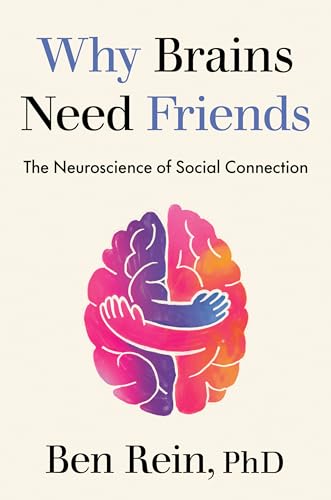
I read most of this book sitting with my grandma, and somewhere in the middle of it we ended up having one of the best conversations we’ve had in a long time, about loneliness, about getting older, about how easy it is to let the people you love slip into the background of a busy life. That conversation is probably the best review I can give this book. It does something rare: it takes a body of scientific research and makes it feel immediately, personally relevant to whoever is in the room with you. My grandma isn’t a neuroscientist. Neither conversation required her to be.
What This Book Is Actually About
Why Brains Need Friends is Dr. Rein’s case for something that sounds simple until you see the full weight of evidence behind it: human beings are hardwired for connection, and when that connection is absent, our health, physical, cognitive, emotional, suffers in measurable, documented ways.
Dr. Rein moves efficiently through the history of socialization research, breaking down decades of neuroscience and psychology without the unnecessary fluff that bogs down so many books in this space. The throughline is clear from the start: we spend enormous energy monitoring and managing what breaks down inside our bodies, diet, sleep, exercise, genetics, while consistently underestimating how much the world outside our bodies shapes our health. Human connection isn’t a lifestyle bonus. It is, the science increasingly suggests, a biological requirement. And understanding the neuroscience of isolation, Dr. Rein argues, could help us come together in a world that is becoming more divided by the year. That’s not a small ambition for a book, and he earns it.
What Got Me Thinking
The highlight that stopped me completely was the data on romantic partnership and cancer mortality. Studies show that people in romantic relationships have a meaningfully higher likelihood of surviving cancer than those who are not. Could there be confounding factors? Absolutely, and Dr. Rein acknowledges that honestly. But he also asks the quieter question underneath the statistics: how much does feeling loved and cared for actually affect our capacity to heal? That question doesn’t have a clean answer yet, and the book doesn’t pretend it does. But sitting with it, especially having just watched my grandma light up in the middle of a conversation she didn’t know she needed, made it feel less like a research question and more like something I already knew in a different register.
What I also appreciated deeply was that the book doesn’t take the easy route of blaming everything on smartphones. Yes, devices are part of the story. But Dr. Rein engages honestly with the more complicated reality: the older we get, the more structurally isolated we tend to become, regardless of screen time. Social networks shrink. Mobility decreases. The infrastructure of daily life stops generating the incidental human contact that younger people take for granted. That’s not a phone problem. It’s a design problem, in how we build communities, care for elderly relatives, and structure the later chapters of a human life.
As a template for accessible science communication, this book is also worth studying in its own right. Dr. Rein demonstrates exactly what it looks like to take a complex body of research and make the takeaway clear without oversimplifying the science. No unnecessary jargon, no hedging so heavy it buries the point. Just evidence, clearly presented, in service of something that matters.
Why I Think You Should Read This
Five out of five, and this is genuinely one of the most giftable science books I’ve come across in this entire reading series. If you have someone in your life who is curious about health or how the brain works but wouldn’t necessarily pick up a neuroscience book on their own, this is the one to hand them. It is the kind of push, seeing all the evidence assembled in one place, that makes you actually want to call someone, visit someone, be more deliberate about the relationships you might have been letting drift.
And go check in on an elderly relative. The book will tell you why. Your gut already knows.
My Takeaway
What I keep coming back to is how much we have medicalized health while simultaneously ignoring one of its most powerful inputs. We optimize sleep, track nutrition, monitor heart rate, and then sit alone scrolling for three hours without registering that as a health behavior at all. Dr. Rein’s book reframes connection not as a soft, emotional nice-to-have but as a hard, biological necessity, one with real correlative data attached to it. In science communication, we talk a lot about making research relevant to people’s daily lives. This book does that effortlessly, because the subject matter already is. The science of why we need each other is, ultimately, a story about all of us.
Come Read Along
Did this one make you want to call someone? Because it absolutely did that to me. I’d love to hear how it landed for you, drop your thoughts in the comments or find me on Instagram. And if you’ve been reading along with the series, you know how much I value the community this has built. That’s not accidental. Turns out brains really do need friends. 📚