
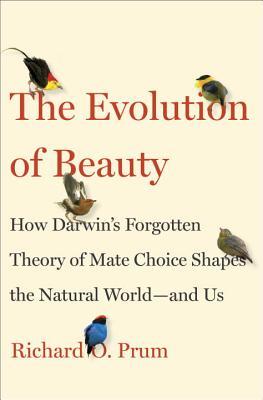
Survival of the fittest. It’s the phrase most of us learned first about evolution, and if you’re anything like me, it became the lens through which almost everything in evolutionary biology made sense. Stronger, faster, better adapted, those traits survive. Simple, clean, satisfying. Except it turns out that’s only part of the story, and the part we’ve been leaving out is, frankly, a lot more interesting. The Evolution of Beauty cracked that lens open for me in the best possible way, and somewhere along the way it also made me seriously consider taking up birdwatching, which I did not see coming.
What This Book Is Actually About
The Evolution of Beauty is ornithologist and evolutionary biologist Richard Prum’s passionate, meticulously argued case for bringing a largely sidelined idea back to the center of evolutionary thinking: sexual selection. Specifically, the power of mate choice, and the radical possibility that aesthetic preferences, the simple fact of finding something beautiful or attractive, can drive evolutionary change entirely independently of survival advantages.
This isn’t a new idea. It comes directly from Charles Darwin, who explored it in his lesser-known second book, The Descent of Man, and Selection in Relation to Sex. Darwin described “the taste for the beautiful” as a distinct evolutionary force, one that operates alongside natural selection but doesn’t answer to it. The idea was largely dismissed or absorbed into the mainstream natural selection framework for over a century. Prum’s book is an extended, evidence-rich argument for why that dismissal was a mistake, and why beauty itself deserves recognition as a genuine driver of how life on Earth has evolved.
What Got Me Thinking
Prum really likes ducks. I say this with complete affection, because by the end of this book he had me thoroughly hooked on ducks too, and on birds generally, in a way I did not anticipate when I picked this up. The physical copy has photographs, and they are genuinely stunning. When you see the iridescent plumage, the elaborate tail feathers, the courtship displays that seem to have no possible survival justification, you start to feel Prum’s argument in a way that pure text can’t quite deliver. These traits exist because they were found beautiful. Because somewhere in evolutionary history, a preference emerged, and the trait that satisfied that preference got passed on, and over generations an extraordinary, seemingly impractical display of color or movement became fixed in a species. Beauty shaped the biology. That idea, once it lands, is hard to let go of.
The section that reorganized something in my thinking most fundamentally was Prum’s treatment of the distinction between natural selection and sexual selection as genuinely separate forces. We tend to assume they converge, that whatever gets selected for sexually must also offer some survival advantage, otherwise why would it persist? Prum argues, with Darwin, that this assumption is wrong. Mate choice can produce traits that are purely aesthetic, that offer no survival edge and may even be costly, simply because the preference for them exists and self-reinforces over time. The taste for the beautiful is its own evolutionary engine.
There are stretches of ornithological detail that go deep, deep enough that I found myself genuinely considering whether a pair of binoculars might be a reasonable next purchase. And toward the end, when Prum extends his framework to human sexual evolution, the argument does become more speculative. That leap from bird behavior to human psychology is a long one, and I think the book is honest enough that you can feel where the firm ground ends and the interpretation begins. It didn’t undermine the earlier chapters for me, it just asked me to hold that section with a little more skepticism.
Why I Think You Should Read This
A solid 4/5 – and the rating is entirely about those speculative stretches at the end, not about any shortage of ideas worth having. Prum’s passion for his subject is present on every page in the best possible way – the kind of infectious enthusiasm that makes you care about things you never expected to care about. Iridescent plumage. Elaborate courtship dances. The evolutionary logic of beauty. I came in mildly curious and came out wanting to learn bird calls.
If you’ve ever felt like the standard survival-of-the-fittest narrative leaves something unexplained about the sheer extravagance of the natural world, the peacock’s tail, the bird of paradise’s dance, the seemingly unnecessary gorgeousness of so much of life on Earth, this book is the answer you were looking for. Highly recommended for anyone curious about evolution beyond the standard narrative.
My Takeaway
What I keep sitting with is how much of the living world we’ve tried to explain through a single lens, usefulness, survival advantage, adaptive value, and how much of it quietly resists that framing. Beauty persists in nature not always because it helps an organism survive, but sometimes simply because it was chosen. Because a preference existed, and the trait that satisfied it got passed on. That’s a different kind of logic than the one I was trained on, and it opens up something generous about how evolution actually works, messier, more aesthetic, more driven by desire than pure utility. As someone who thinks about science communication, I find that humanizing. The natural world isn’t just optimizing. Sometimes it’s just making something beautiful because something else found it beautiful first.
Come Read Along
Has this one shifted how you think about evolution, or do you have a favorite example of a trait that seems to defy simple survival logic? Drop it in the comments or find me on Instagram. And if anyone else is now considering birdwatching after reading this, please let me know immediately so we can compare notes.
February’s Science Read is Enshittification by Cory Doctorow, a complete tonal departure from the birds and the bees, but equally hard to put down. See you there. 📚